In early August 2025, after a gap of 4 months I was fortunate enough to hit the Eastern European capital city trail once more, with an impromptu visit to Budapest, the capital of Hungary.
Wow! What a city. What a trip.
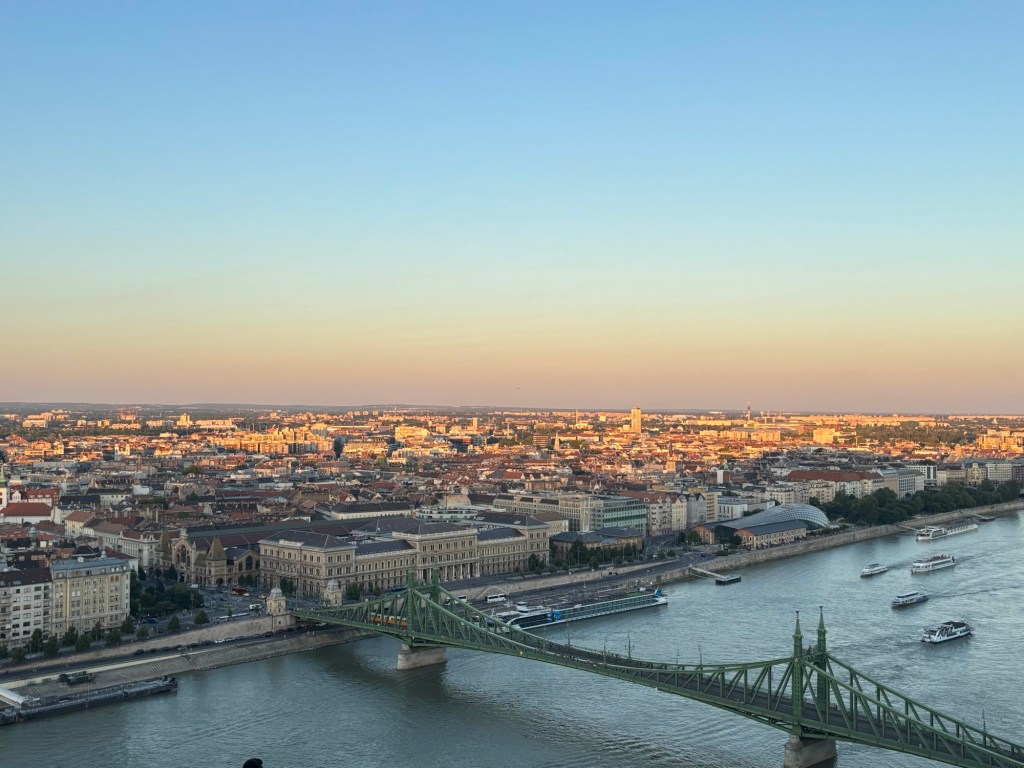
We only visited for 72 hours, but were fortunate enough to pack so much in and I still have a ‘wish list’ of so much more for discovery the next time I go.
Yes! God willing, there will definitely be a next time!
This was my second visit to Hungary, having visited Budapest 7 years earlier in November 2018 with my wife Nicky.
This time my travelling companion was my youngest son Jake. He had been invited to Budapest to speak at a nuclear energy convention and when it proved impossible for his wife Abi to travel with him, I got the nod and was offered the gig.
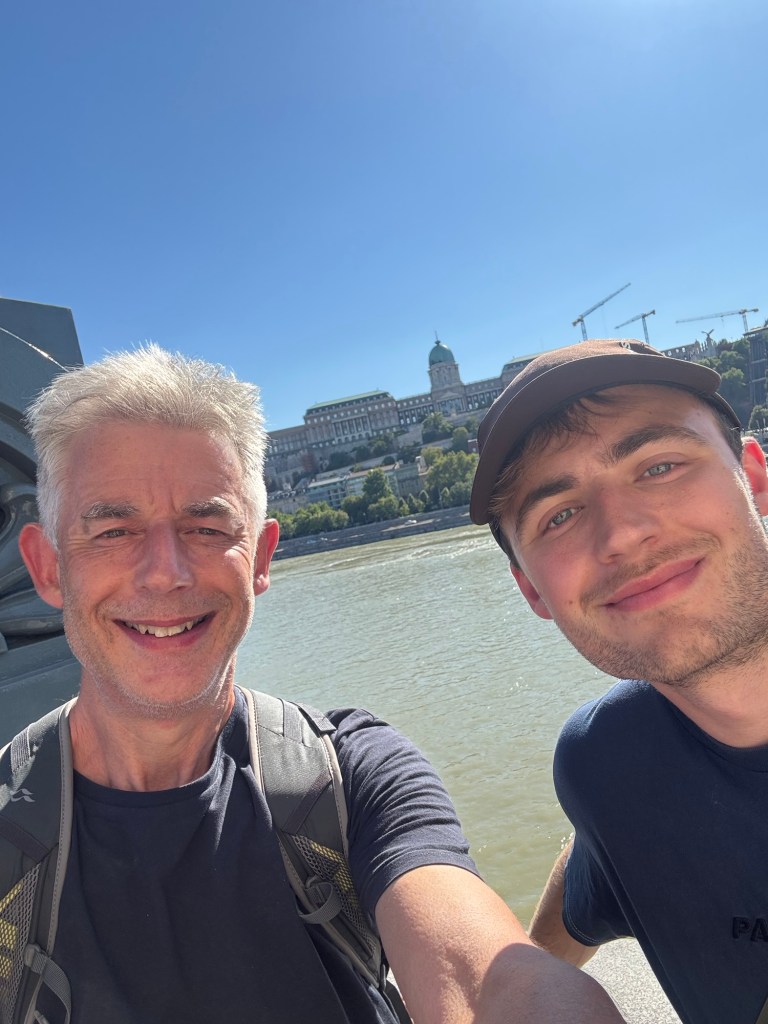
It would have been rude turn him down!
So whilst he talked drivel with his nuclear comrades, I got to mooch around the city.
From this mooch 2 blogs were born.
This one about the city itself and its history and then a second (still in draft form) which focusses on the city’s Jewish ancestry and the barbaric treatment that these people received at the hands of the Nazis during the final 2 years of World War 2.
Before I give you a taste of Budapest’s history, I need to pay tribute to my beautiful wife Nicky, Jake’s mum, who showed great grace and sacrifice in supporting my trip: especially when I got invited and she didn’t!
Apparently Jake is speaking at a conference in Whitehaven (England) soon and I intend to do the honourable thing too and let Nicky go!
Nicky had visited Budapest back in 2018 with me: it is the one European city that she has constantly wanted to return to. So to see her husband jetting off on a ‘corporate assisted jolly’ must have been galling.
Her class is clear to all: she never complained; not once.
Jake’s conference was based at the 5* Osana hotel complete with thermal spa.

The hotel itself is lovely. The rooms are large and spacious with air conditioning: so welcome in the summer heat where our daily outdoor temperatures ranged between 32-35 degrees. The spa facilities are extensive: indoor and outdoor pools, sauna, steam rooms and 2 thermally heated pools boasting temperatures of 33-37 degrees.
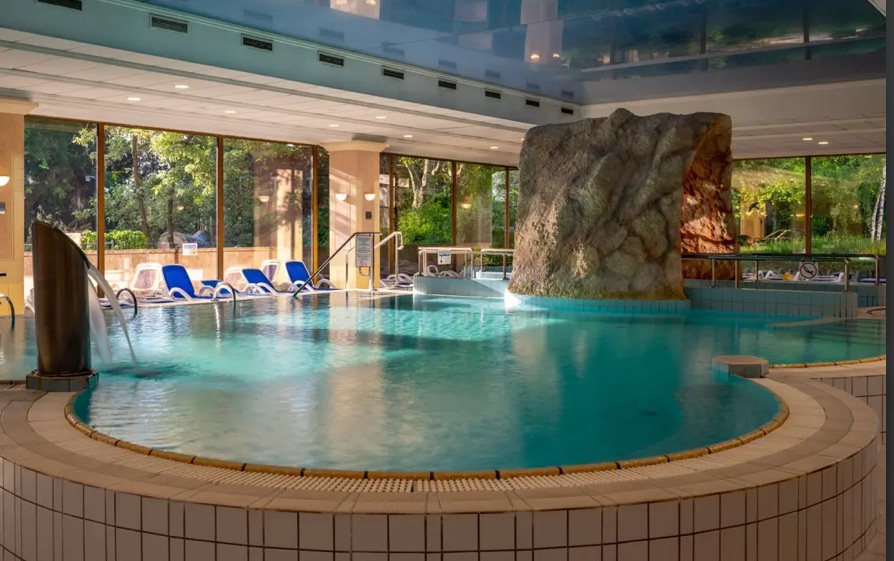
It seemed the water temperature indoors were a coincidental daily match to the air temperature outside.
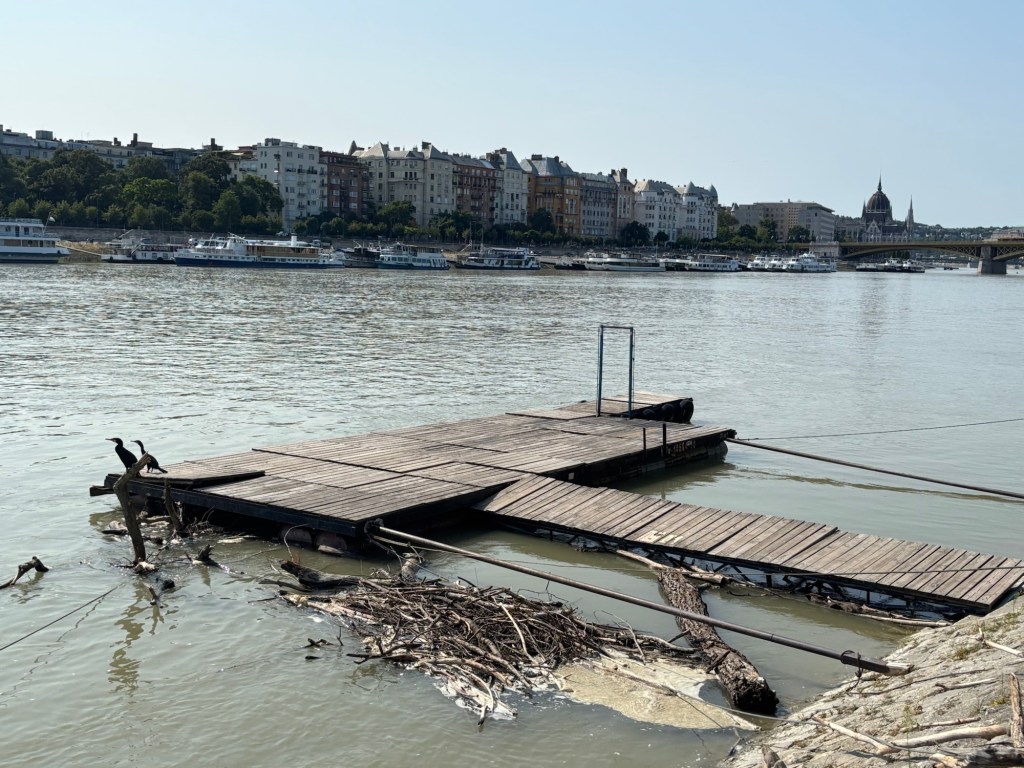
The hotel is based on the northern most tip of Margaret island meaning it is a 5km journey into the historic city centre with its multitude of attractions. Fortunately public transport is cheap and reliable with a bus into the city costing less than £1.
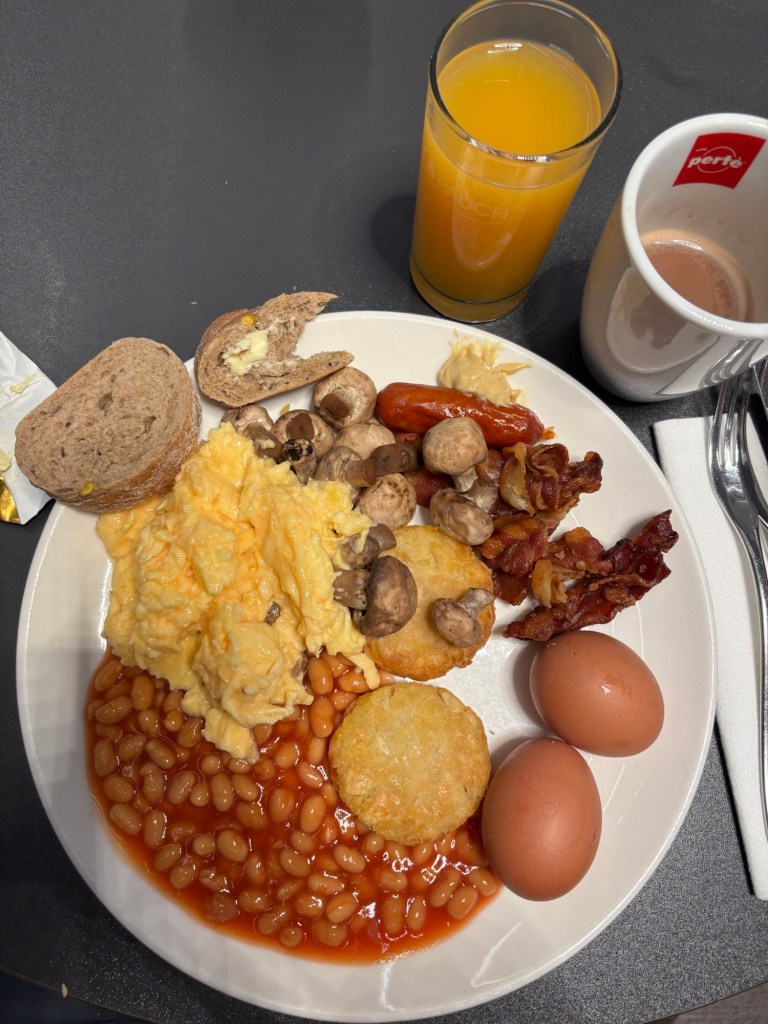
After a ‘eat as much as you like’ breakfast on both of the full days of my visit I really enjoyed walking the 45 minute saunter along the Danube to the city.
I didn’t have to walk. Trams, buses, taxis, bikes and scooters are readily available to hire. This city however, is a city that encourages a walking tourist. So much to see and even in the heat of summer, a morning amble is so rewarding.
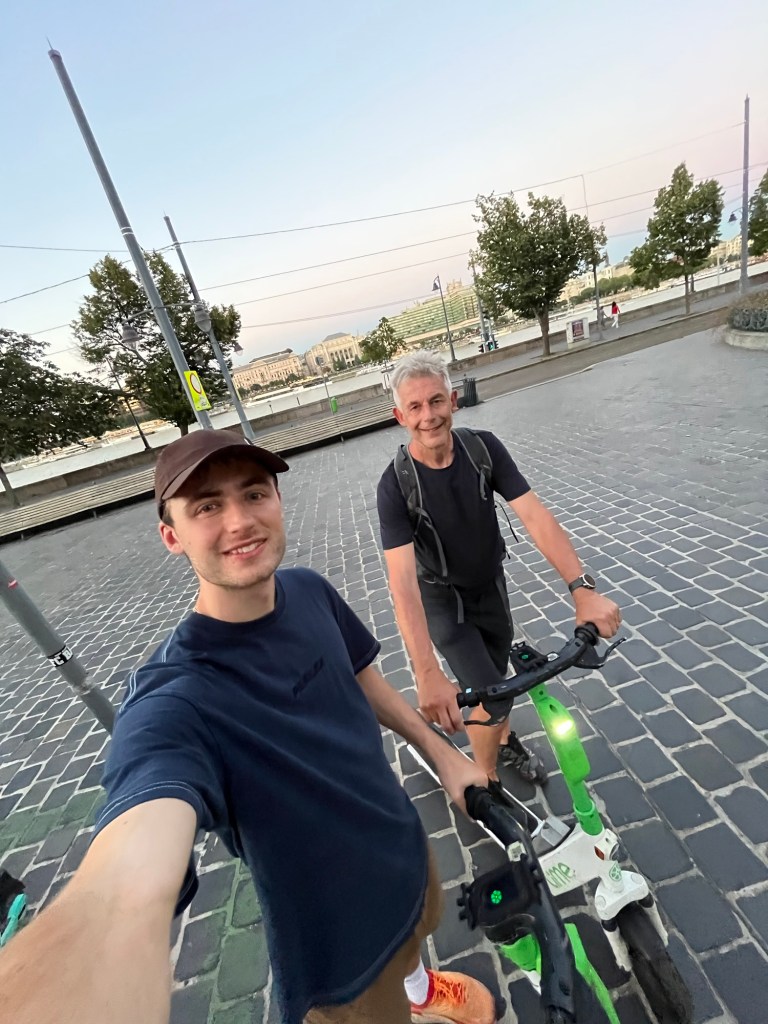
The population of Budapest is estimated at 1.7 million people with 1.5 million in Buda and 250,000 in Pest. The city is very compact and if you are an able walker then seeing the city on foot is very easy. On the Friday, when we walked so much of the city we actually walked 30,000 steps: not bad in temperatures of 33 degrees. We did hire scooters for our 5km journey back to Margaret Island. That would have been 5 km too far on foot!
Scooter hire is easy.

Apparently Russell Crowe was in town at the time we visited.
They are available on most street corners in the city and easily booked using the local app. This 20 minute ride cost us approximately €3.50 each and was great fun! Safe too as it was a journey along specially designated and well maintained scooter/bike lanes.
Detailing the fascinating influence of this extraordinary Jewish culture on the city of Budapest, will be the theme of a second blog about the city.
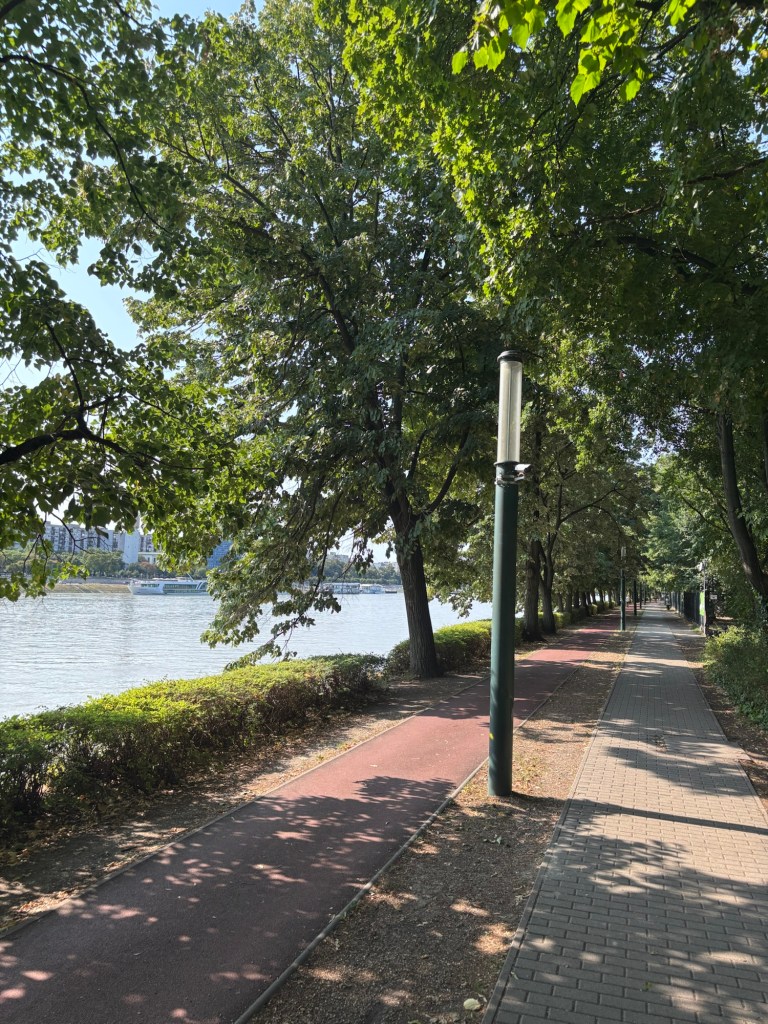
The island has a unique 5km long single running track around its perimeter. I walked along this to the city on my first full day. 3 hours later in the midday heat Jake decided to run this track, after completing his ‘panel’ duties at the conference.
Further internet research reports : “Live In Budapest (later repackaged as Hungarian Rhapsody), the Népstadion crowd were word-perfect as the band rolled out the hits (the government’s “lenient restriction on audience behaviour” allowed singing and clapping, if not smoking and drinking).” A €5 day ticket allows you to visit some of the parliament building.
‘Mad dogs and Englishmen go out in the midday sun’ apparently. Mad he might be, but Jake was still buzzing after setting a personal best 5km running time of 23 minutes 24 seconds!
The unique combination of warm weather, a ‘suspension’ rubber crumb running track and a desire to set his best ever time, meant that his mission was accomplished!
Sadly my knees don’t enjoy the pounding of running anymore. So I was content to stroll riverside towards the city.
In recent post pandemic years my wife and I have used our retirement to visit a number of European cities, mostly capitals and mostly in the former Soviet block.
We don’t take this privilege lightly. In doing so we have come to realise that booking a free city tour with a guide (you tip the guide based on how interesting they make it) is the perfect way to get your bearings, familiarise yourself with the best sites and attractions and generally immerse yourself into the unknown vibe of the city.
I had pre booked my 2.5 hour ‘Budapest City’ Guru tour for 11.00. It was superb. As always! If you are interested, just make your internet booking and on the arranged day go find your guide complete with their distinctly visible red umbrella. (© GuruWalk SL)

Budapest holds a complicated and at times challenging history, such a common theme in this Eastern European region, where its nations have faced invasion and occupation from so many monarchical and despotic regimes over the centuries.
We had learned so much on our free city tours during recent visits to Prague, Krakow, Riga, Bratislava, Bucharest and Poznan: nations who had all suffered in recent history at the hands of the Russian or German Empires, and some of their more brutal leaders men like Adolf Hitler and Joseph Stalin.
Over the last millennium Budapest had faced additional occupation and persecution from the Ottomon and Austrian empires. The result? A 1000 year existence forged so dramatically by the domination of other nationalities.
In the tour we were told how the city was first established in 896 by 7 pagan tribes from the Carpathian Mountains, before becoming a Christian country in the year 1000.
This was the start of the time when the reputation of Hungarians (Magyars) for being brilliant horse riders, often riding no handed whilst facing backwards, was forged.
Their horse riding skills at the start of the second millennium and the agility of their steeds meant that any local opposition was swiftly defeated.
The pagan rule lasted just 100 years before Budapest became a Christian city, under its first king, Stephen 1. He was the ruler to be credited by modern day Hungarians with “solidifying our place in Europe.”
Apparently the Jews had settled in the area before the Carpathians and their thousand year old influence on the city and its culture is still very apparent today as you walk the streets of Budapest.
The Jewish population had mostly lived in Buda (the other side of the city to most of its attractions today).
At that time there were no bridges so a ferry toll was levied on residents to cross the river to Pest.
For 145 years in the Middle Ages the city was part of the Ottoman Empire that originated in Turkey.
Under the Austrian (Hapsburg) Empire significant numbers of the Jewish population were slaughtered in 1686: sadly not the only time people with a Jewish heritage were to be brutalised in Budapest.
The Jews survived this purge, and under their continued influence the city started to develop an international reputation in the late 1700’s.
Even so, restrictive laws still meant that a Jew wasn’t allowed to own property in the city: a stance that was only to change in the late 1700’s as the ruling Austrian Hungarian Empite in 1867, finally accepted their significance in the city and agreed that its Jewish community could be emancipated: a decision ratified by congress in 1868.
In 1896 on its 1000th anniversary as a European city, Hungarians were able to celebrate the role of Budapest as city of similar importance to Vienna, Prague and Bucharest.
The ‘golden age’ of Budapest had begun by the time the building of St Stephen’s Basilica, such a grand building in the heart of the city, was completed.
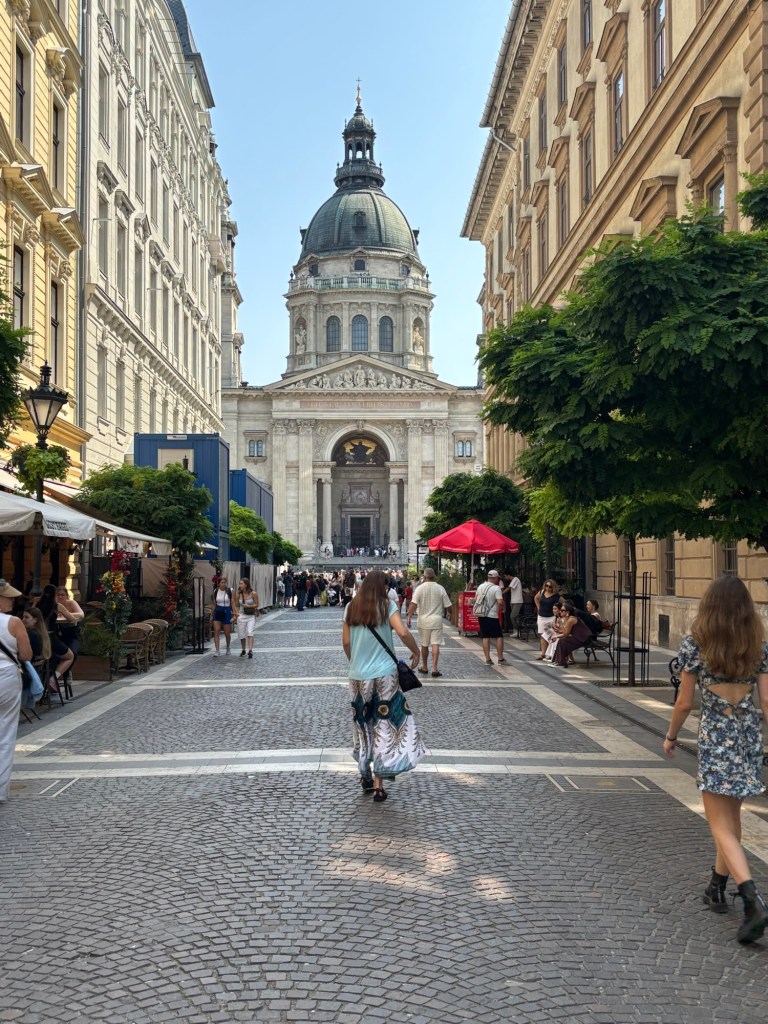
Once again its Jewish population were largely responsible for this development.
In 1838, this part of Pest had been a small hill which often flooded badly. The Jews took over the area, cleared away the brothels and paved the way for the building of the basilica and in the process helped to reverse a famous Hungarian saying: “you can’t build a castle out of shit’.
The building of the basilica was finished in 1905
The basilica is full of history and legend.
King Stephen eventually gained canonisation from the Vatican, a decision mostly forged on the belief that his right hand didn’t wither in his grave.
Hungarians joke that the basilica contains a perfect combination: King Stephen’s right hand and the famous left foot of Puskas: the greatest footballer to ever come out of Hungary.
Ferenc Puskás played against England on November 25, 1953, in what is known as the “Match of the Century” at Wembley Stadium. His Hungarian team defeated England 6-3, with Puskás scoring two of the goals. The match was revolutionary for its time, showcasing Hungary’s superior tactical formations and superior fitness, which led to the team’s emphatic victory and marked England’s first home defeat to a foreign opponent.
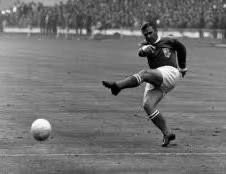
As a keen football supporter, I was quite happy to report to my tour guide that I had no recollection of this famous football result!
The basilica has a 96 metres tall tower: which presents the modern tourist with a spectacular aerial view of the city.
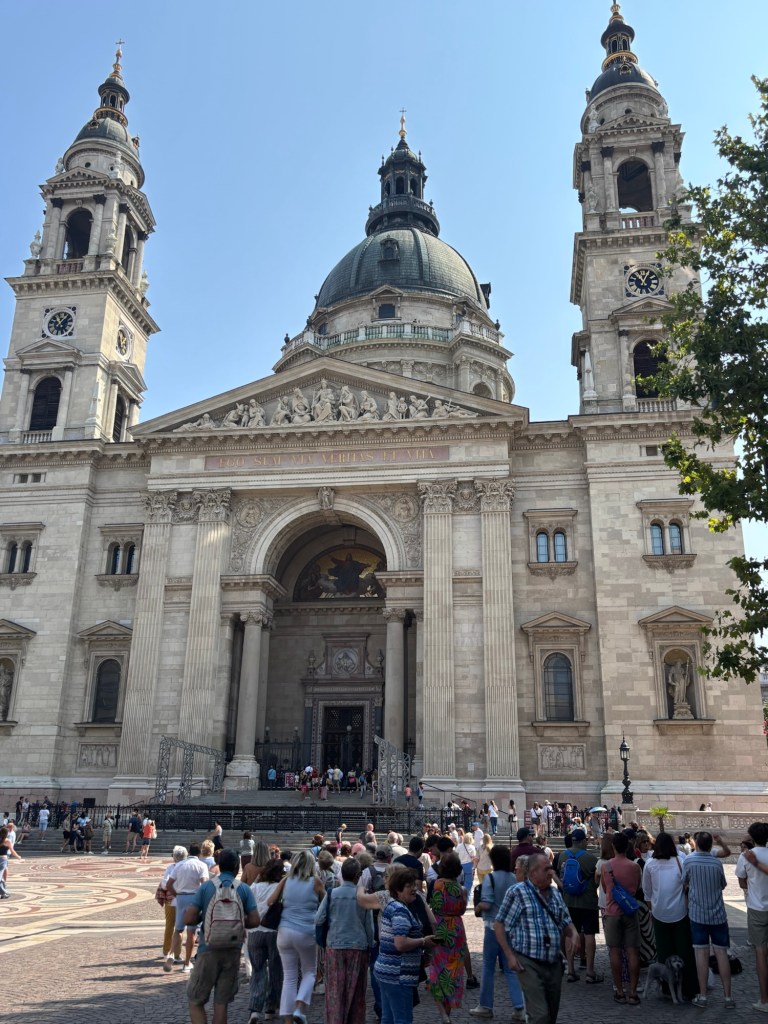
Entry to the basilica and tower is expensive. In truth, the cheap European city that my wife and I experienced in 2017 has become more expensive.
Whilst still cheaper than London entry prices to its historic sites is dear: €32 for the Grand Synagogue, €15 for the tower itself on top of another €15 for the basilica.
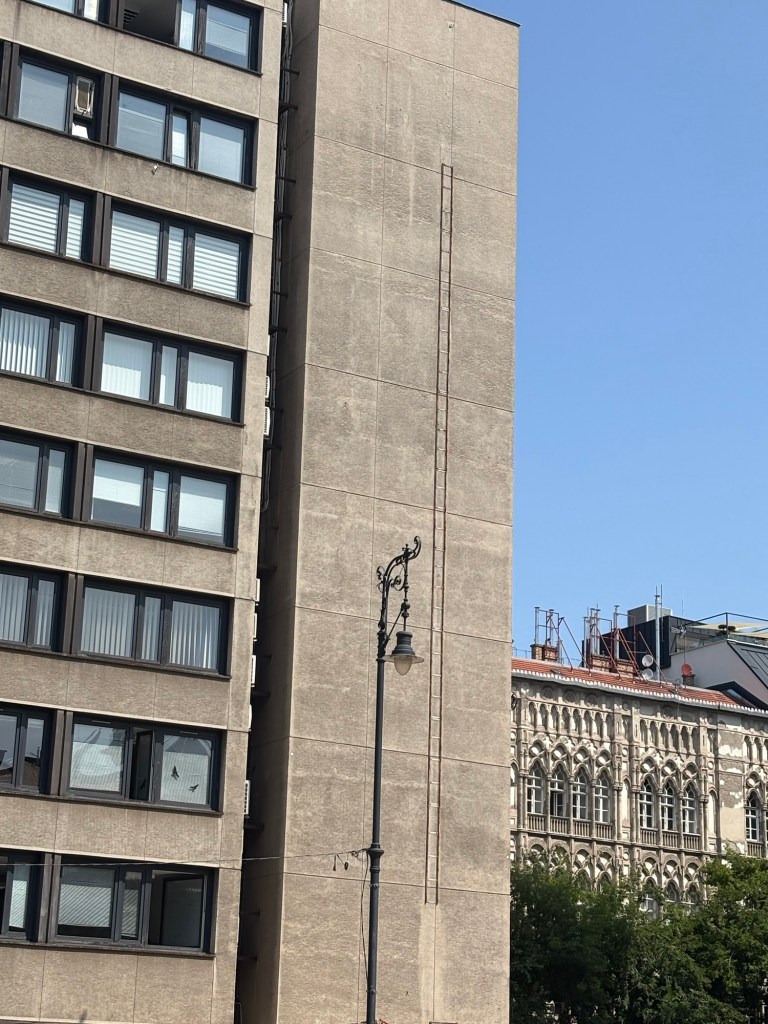
A random concrete building stood next to the basilica. I asked our guide, but he had no answer to my question about what the 30+ metre long ladder depicted on the side of this otherwise unspectacular building.
A Latin carving of the biblical text from John’s gospel 14:6 declares ‘I am the way the truth and the life’ and adorns the basilica’s facade.
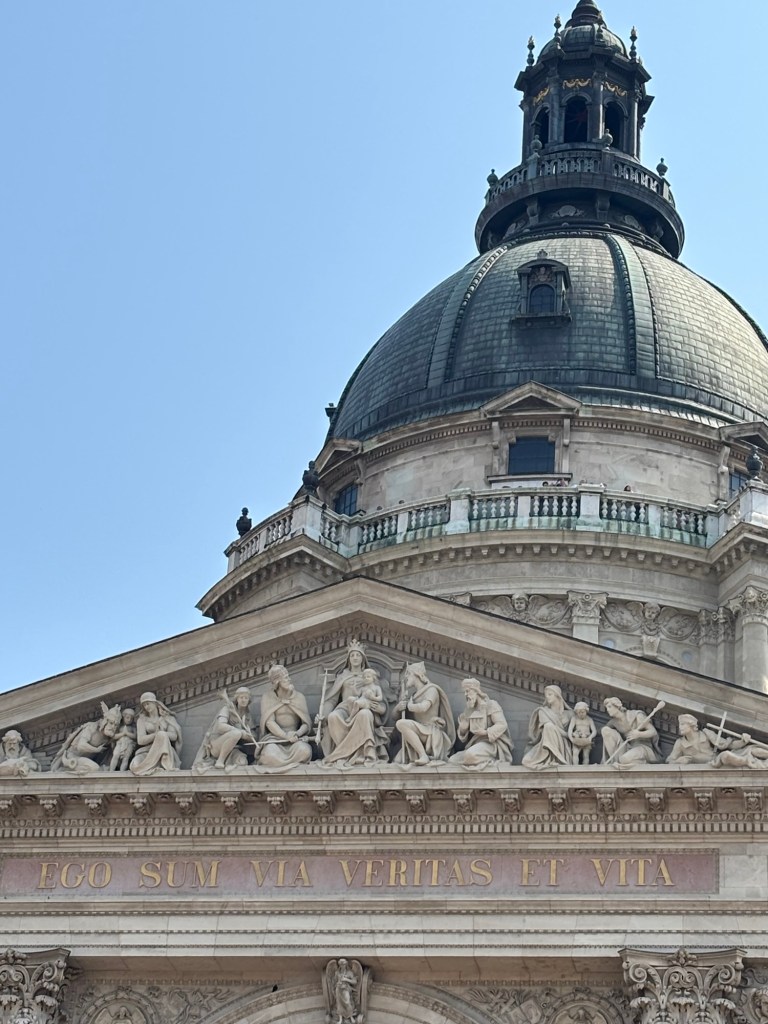
Modern day Budapest is attributed to still be 90% Christian although this is not endorsed by church attendance figures today. Most tour guides now identify Hungary as a mostly atheist country.
On Thursdays and Sundays the basilica hosts classical concerts throughout the year: these concert are free on Sundays though you do still have to pay to enter the basilica. On Thursdays the concerts cost €30.
Magnificent buildings are visible on every street corner.
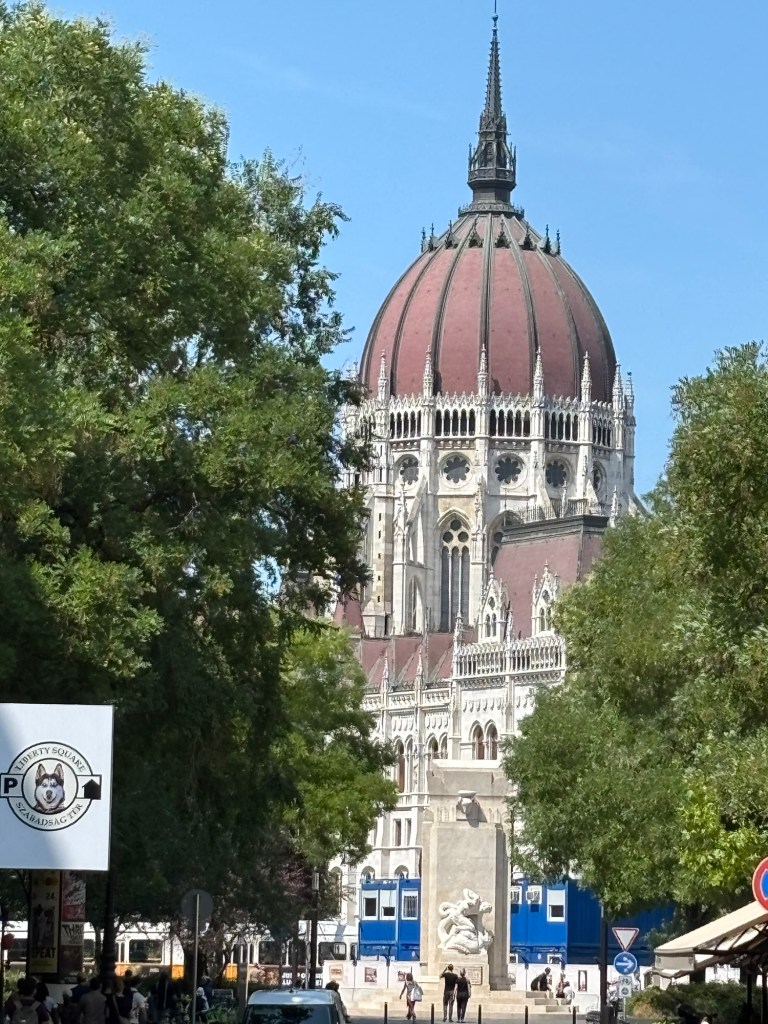
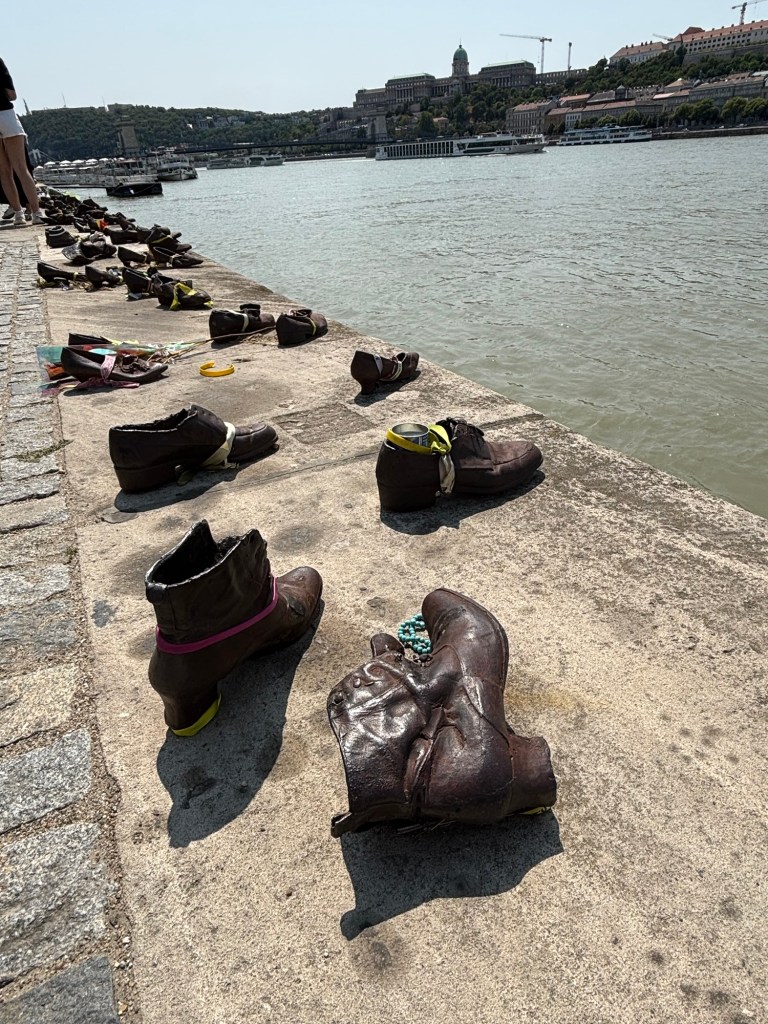
The Parliament buildings, based on the British Houses of Parliament, are riverside and less than 200 metres from the tragically iconic ‘Shoes on the Danube’ sculpture, which marks the spot where hundreds of local people were rounded up on the river bank and shot by the Nazis in in the latter part of World War 2.
Other monuments are dotted across the city.
The city has very little graffiti or street art. What I did find was generally impressive though.
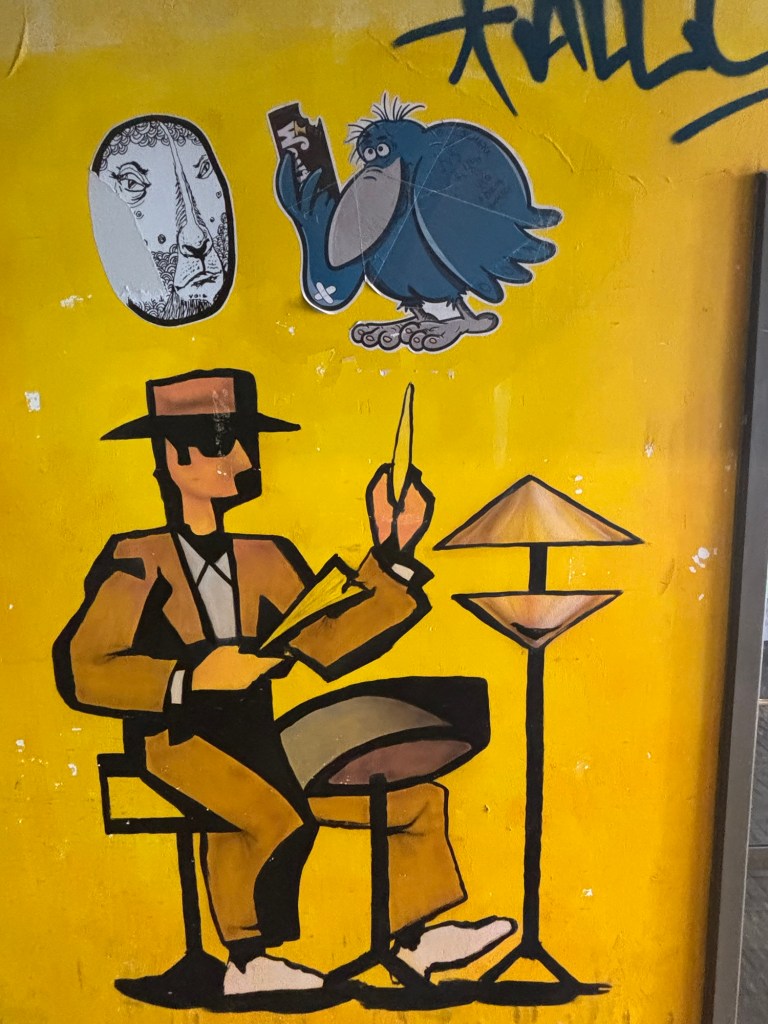
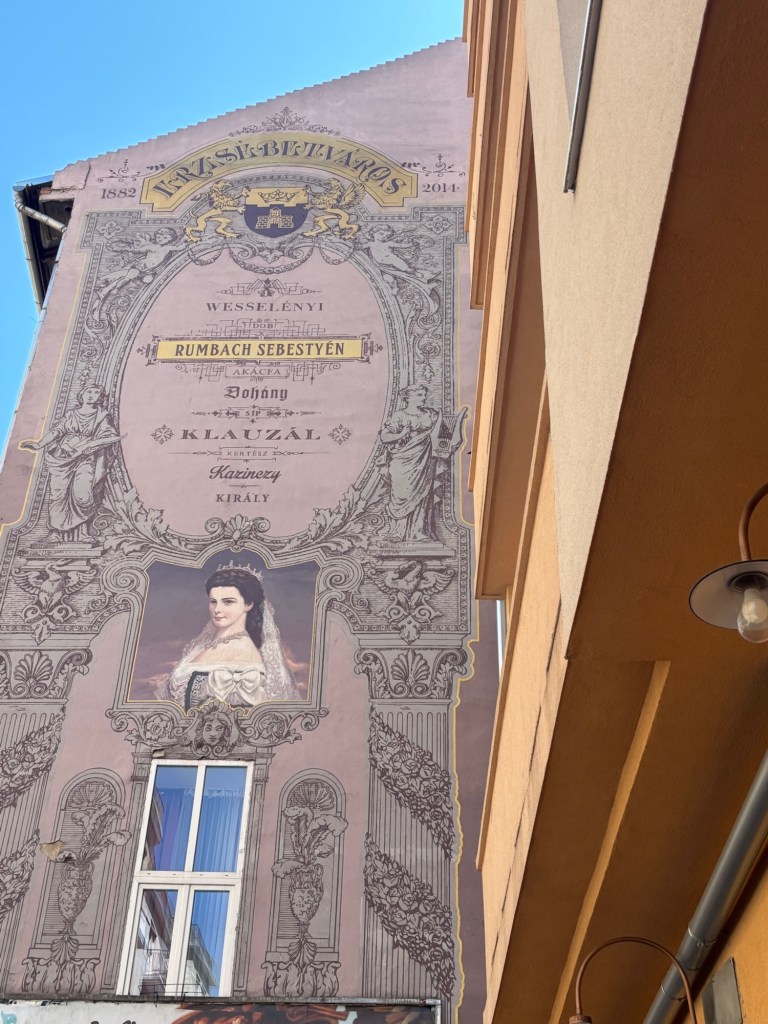
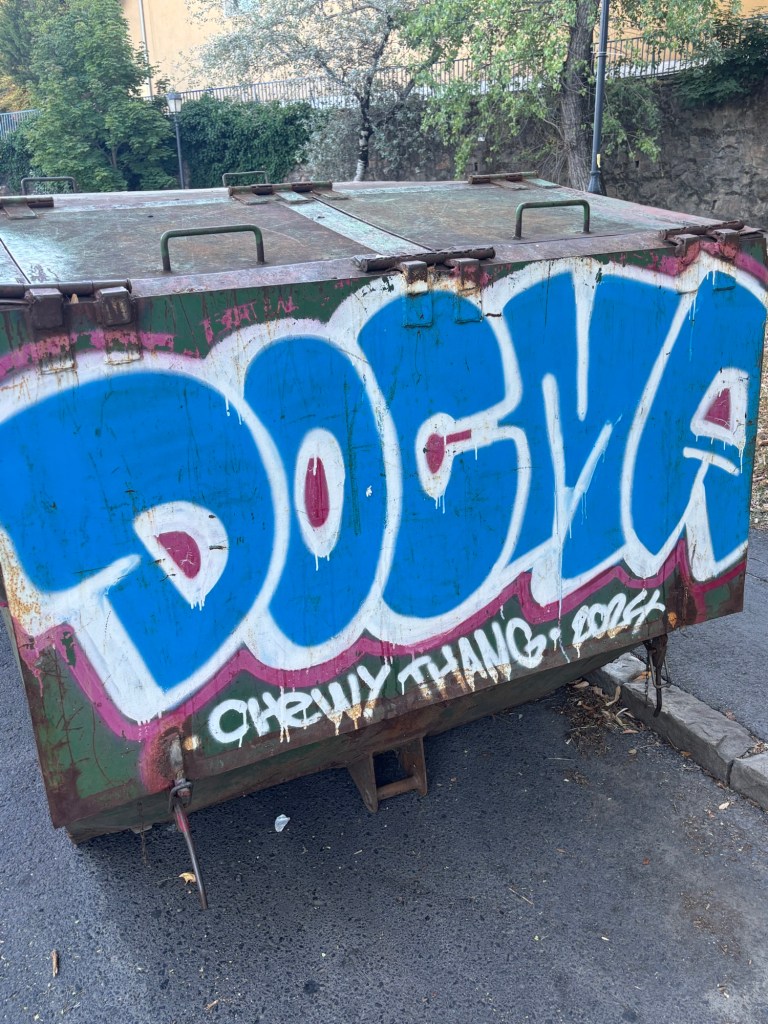
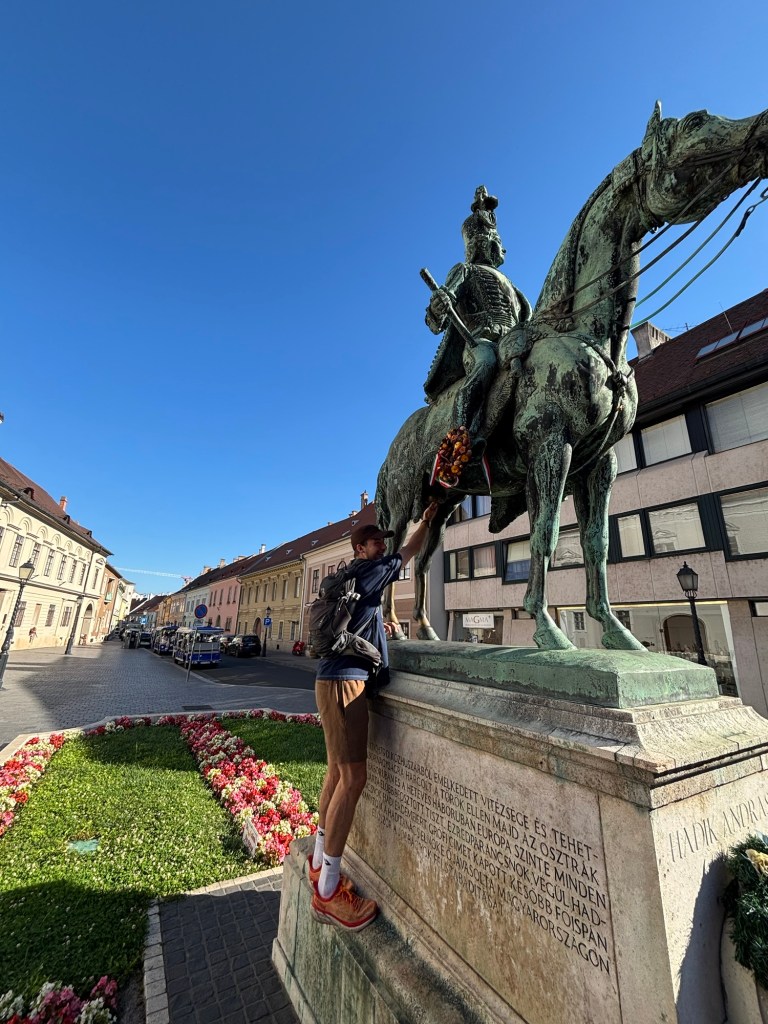
We were particularly taken with the legend behind the statue of Andras Hadik across the river in Pest.
The statue’s good luck tradition encourages visitors to polish the horse’s testicles which is believed to bring luck before exams. The tradition requires climbing, as the statue stands on a tall pedestal, making it more of a challenge. Signage clearly says no climbing. Fortunately Jake is tall, so he stretched the climbing rule to complete his polishing challenge!
Whilst he currently has no exams to sit I’m sure he will have appreciated that opportunity to follow tradition and tickle that horses testicles!
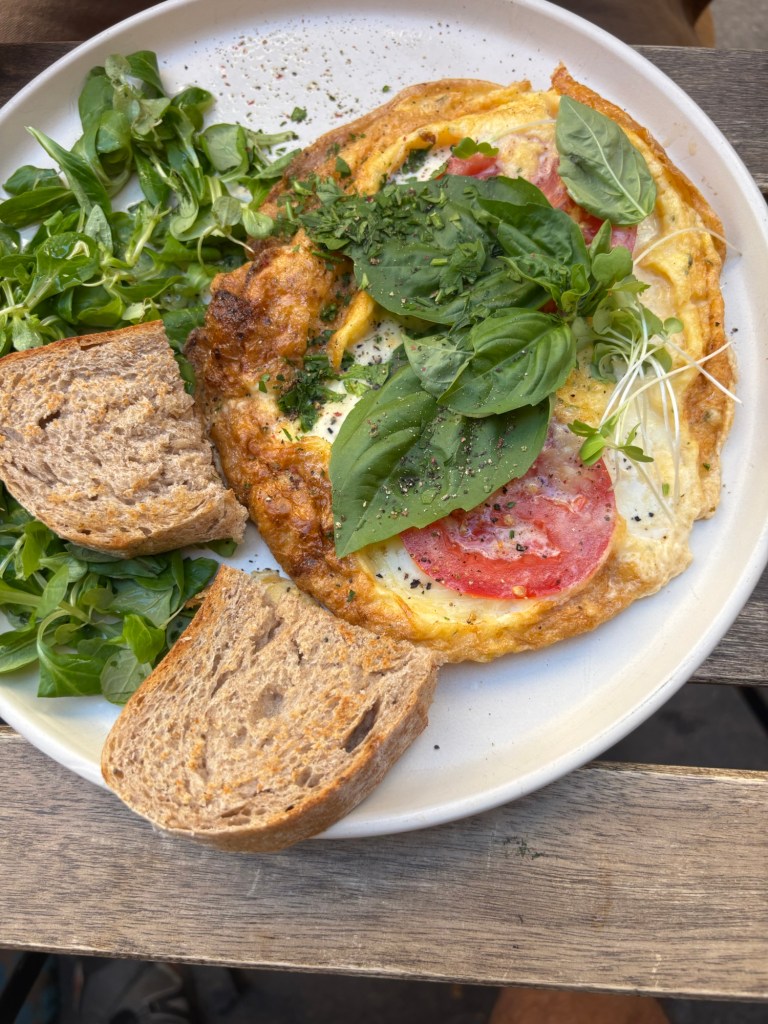
Eating out in Budapest is an excellent and affordable experience. A wide range of options are available including well reviewed Hungarian cuisine.
We chose other options to eat as I’m not especially fond of the Hungarian traditional meat and potato based diet and goulash.


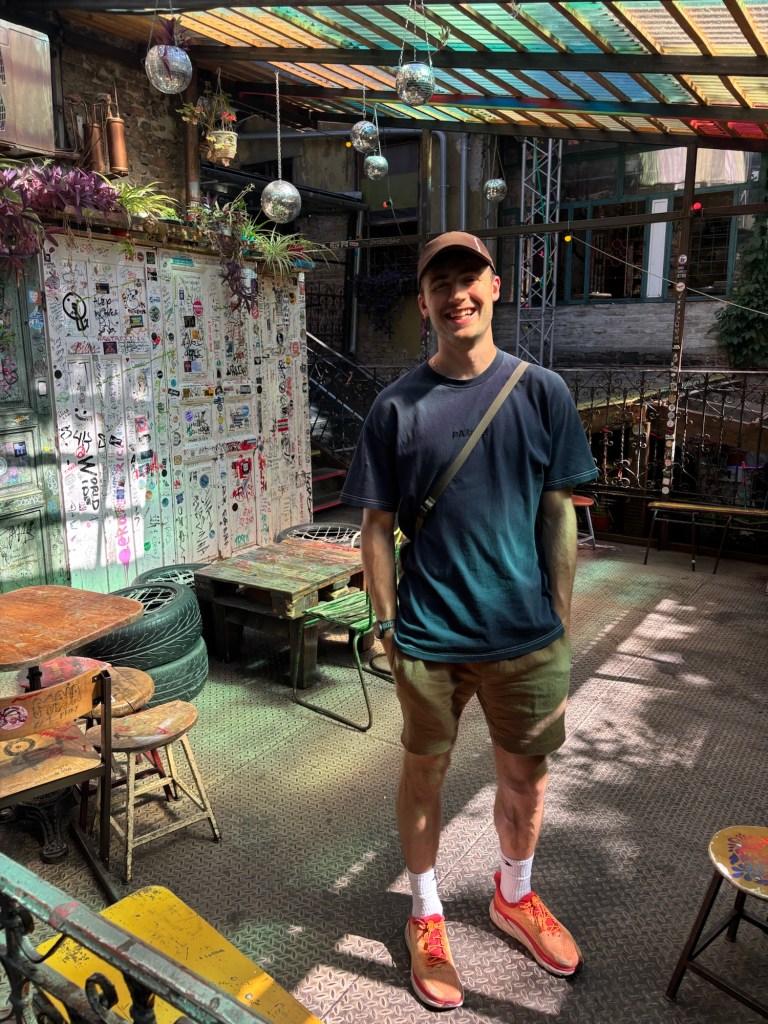
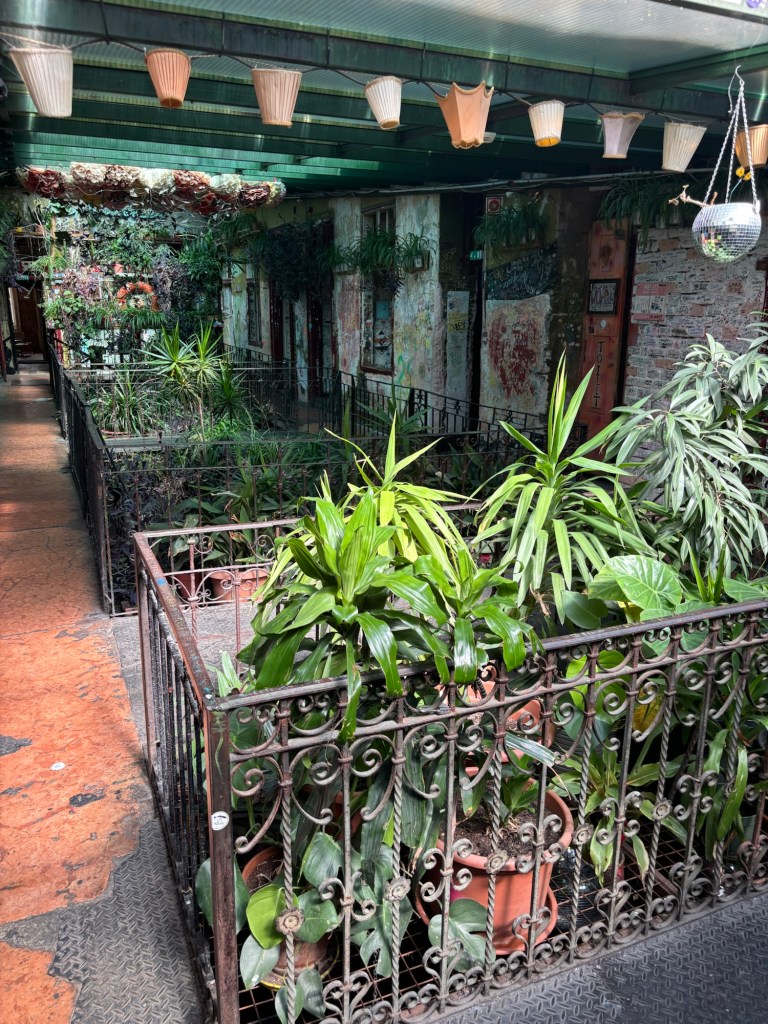
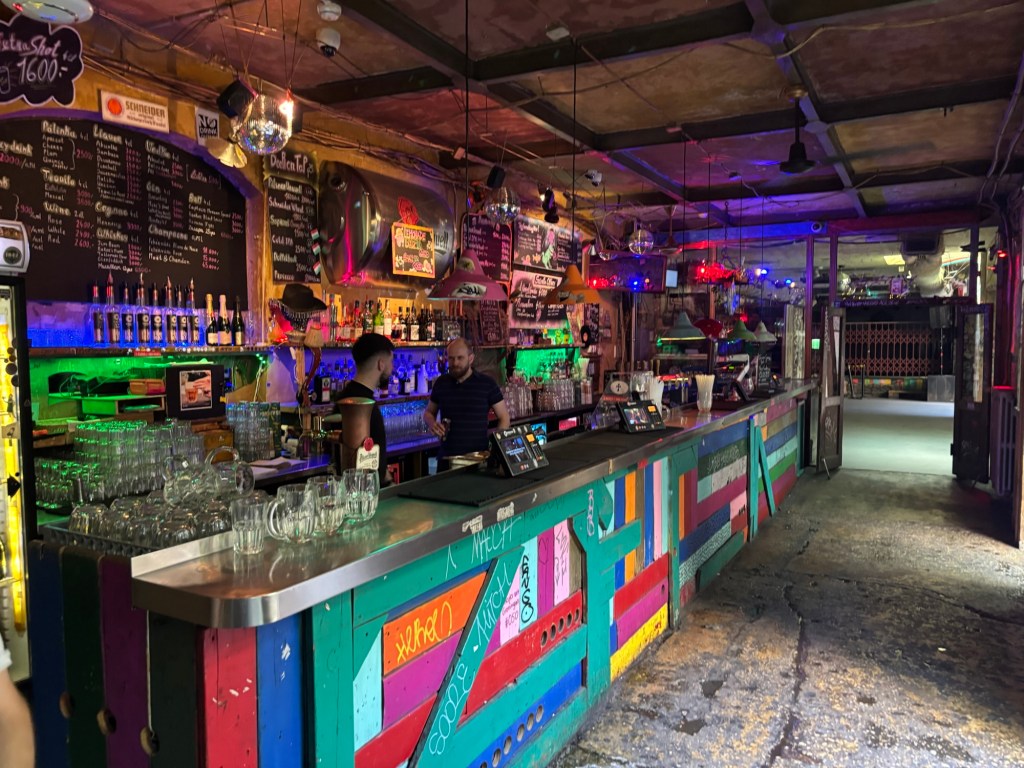
A visit to the world famous‘ Ruins Bar’ is an experience not to be missed.
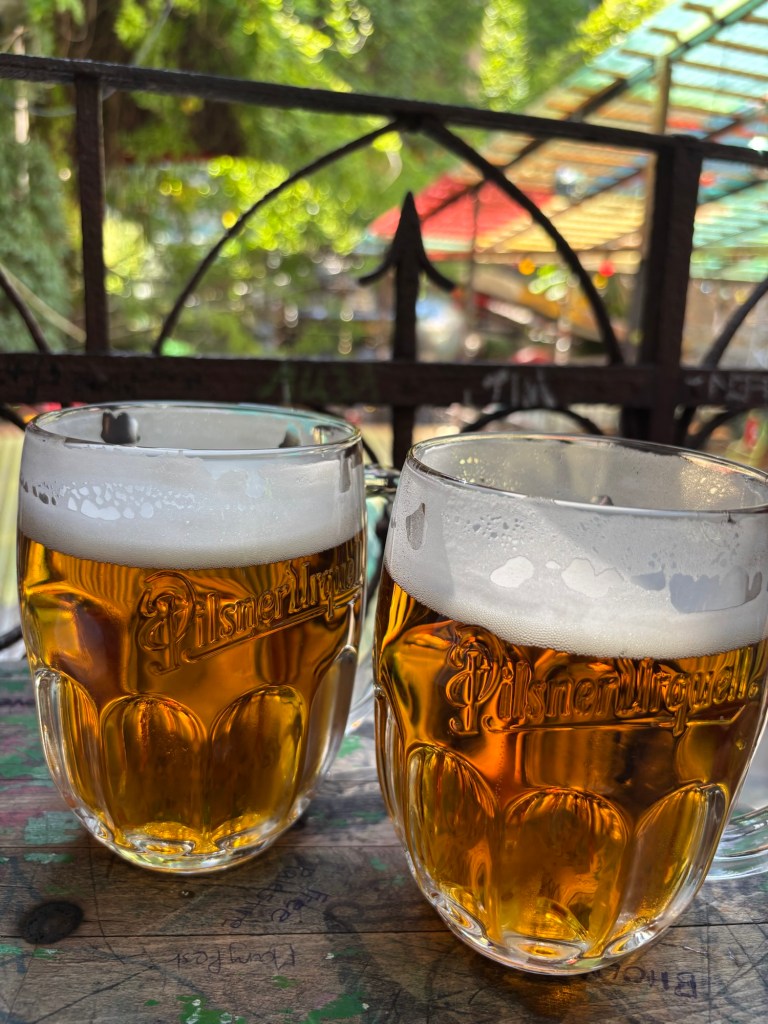
A pint of local beer costs €4 and the ambiance was second to none.
What a fantastic ‘up-cycled vintage’ look it presented.
Freedom Square in central Buda is definitely worth a visit.
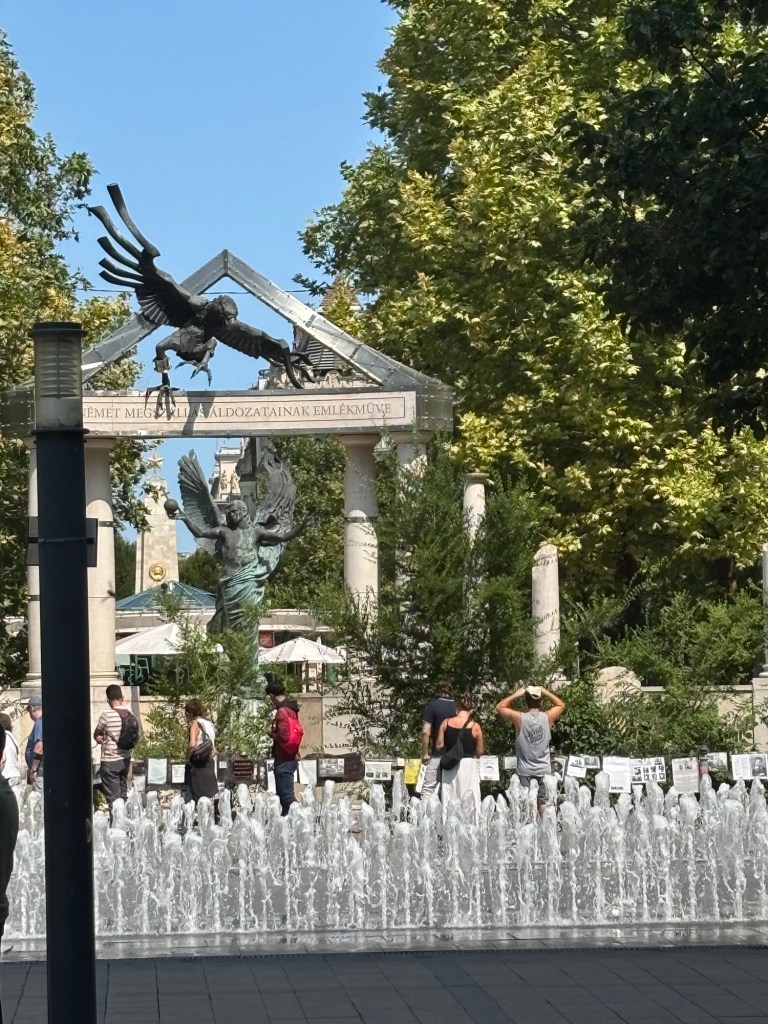
The central sculpture installed in 2014 drew controversy when it was first unveiled as it seems to lay the blame for Hungary’s support of Hitler and his Nazis from World War 2, firmly at the door of the Germans.
Hungarians are still keen to express remorse and admit responsibility for their country’s support of Hitler and his henchmen.
Huge rally’s were held after the sculpture’s installation as modern day Hungarians protested that their government were trying to whitewash the role of Hungary in this dark chapter in its recent history.
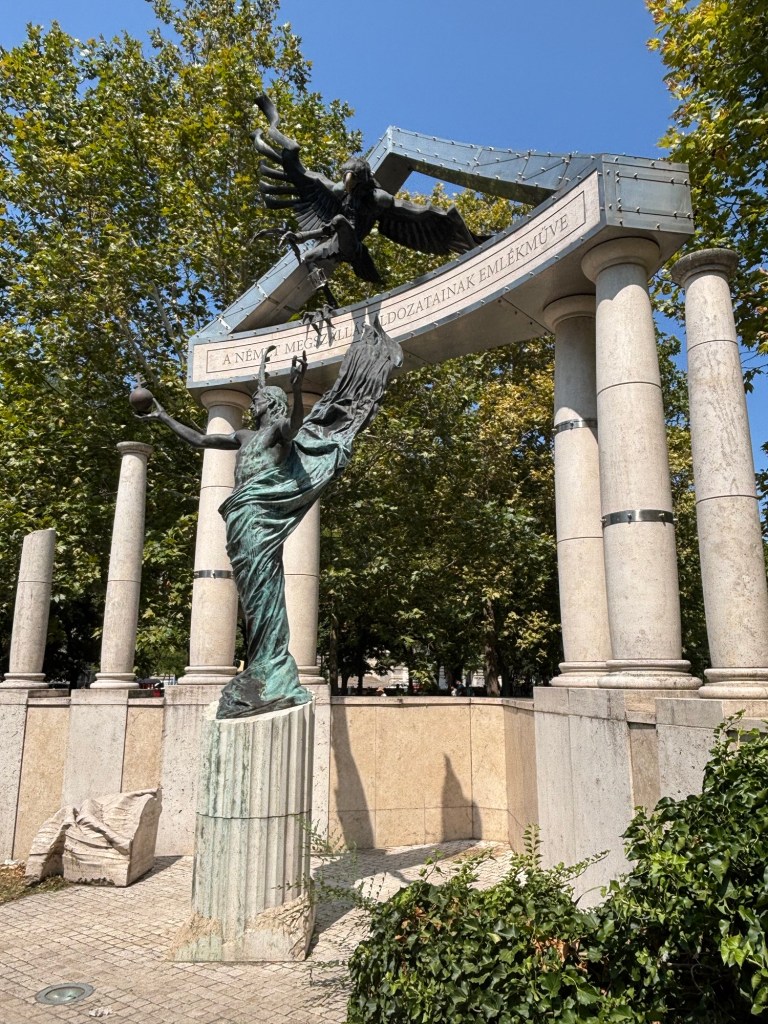
Apparently there is a heavily fortified bunker under the square, ready for political leaders to use as a shelter if atomic Armageddon was ever to become a reality.
The monument remains on public display despite these protests.
Budapest has strong links with Hollywood film makers.
In 2009 a wealthy Canadian bought a large centrally based building intending to create modern day apartments.
The building has been used by the film industry ever since with Tom Cruise a frequent visitor.
Our guide told us that the city’s great history feeds the Hollywood’s ‘vibe’ for movie making. Bladerunner, Mission Impossible and Diehard 5 were all filmed here.
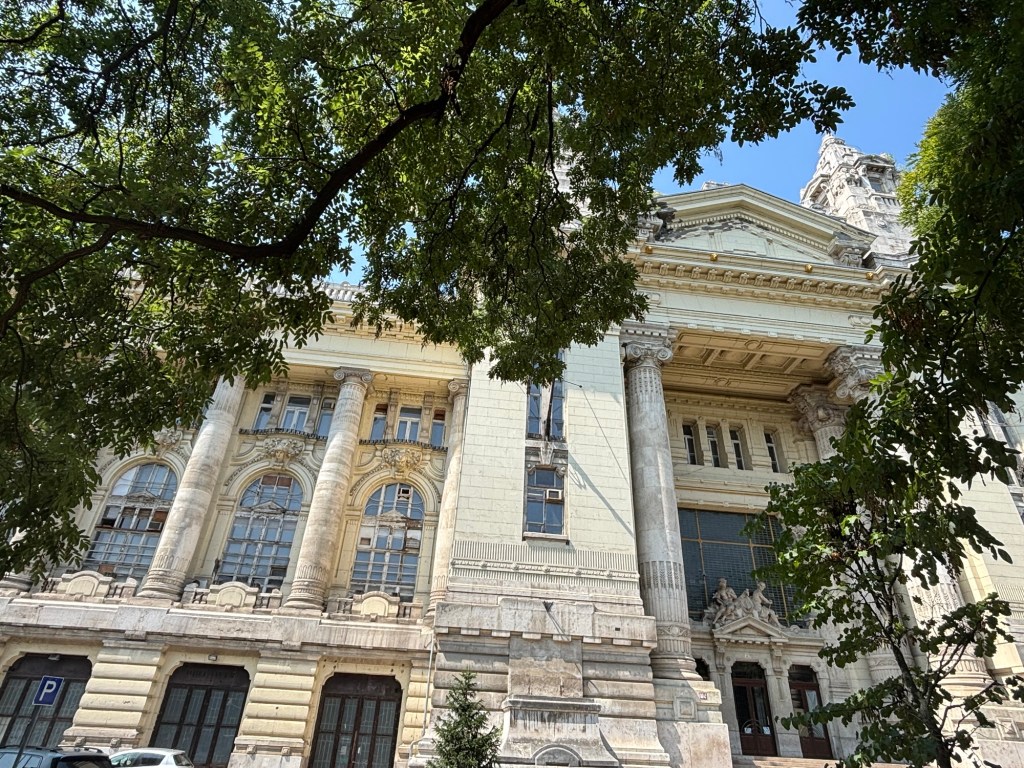
Contrary to speculation the Grand Budapest lHotel was NOT filmed here.
Erno Rubik was born in Budapest.
He was the inventor of the famous Rubik’s Cube, a popular toy of the 1980’s.
The current world record for completion of this mathematical puzzle is now 3.4 seconds apparently: unbelievable!
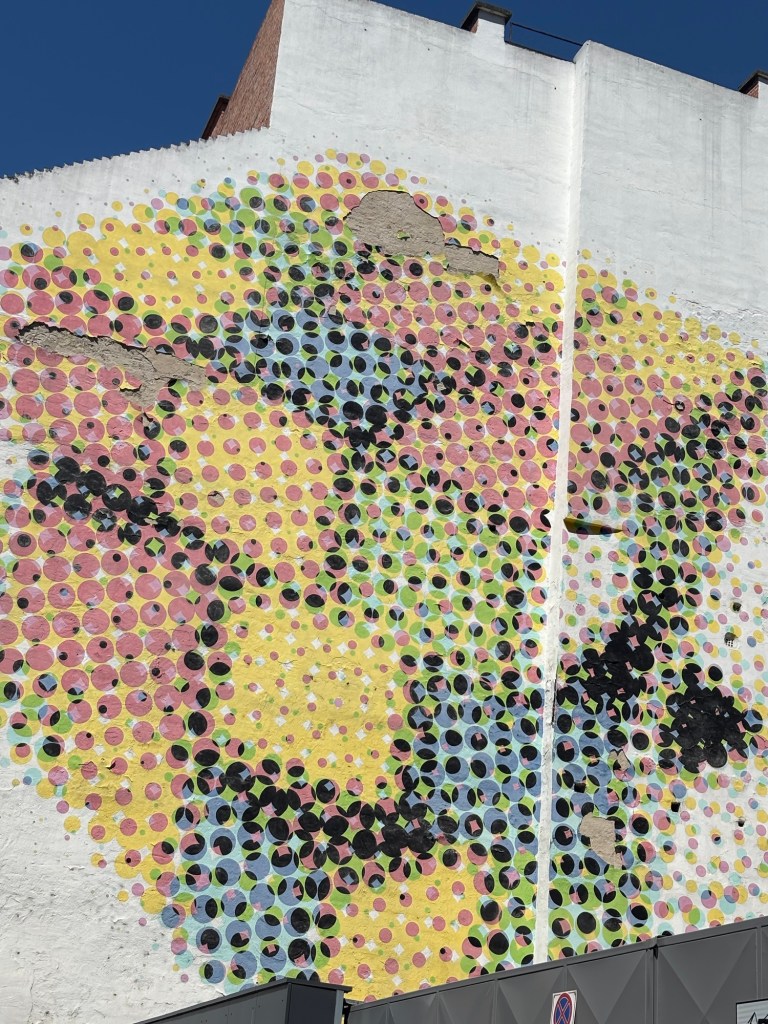
The Ball point pen or ‘biro’ was first invented in Budapest.
Washing hands before surgery was first suggested by a Hungarian scientist who lived in Budapest.
Other famous Hungarians from Budapest include the composer Franz Liszt, escapologist Harry Houdini and actress Zsa Zsa Gabor
Hungarians apparently share an obsession with Kermit the Frog with 40 bronze Kermit’s prominently displayed around the city for the modern tourist to identify.
Rather bizarrely, the Hungarians love ‘The Muppet Show’ apparently.
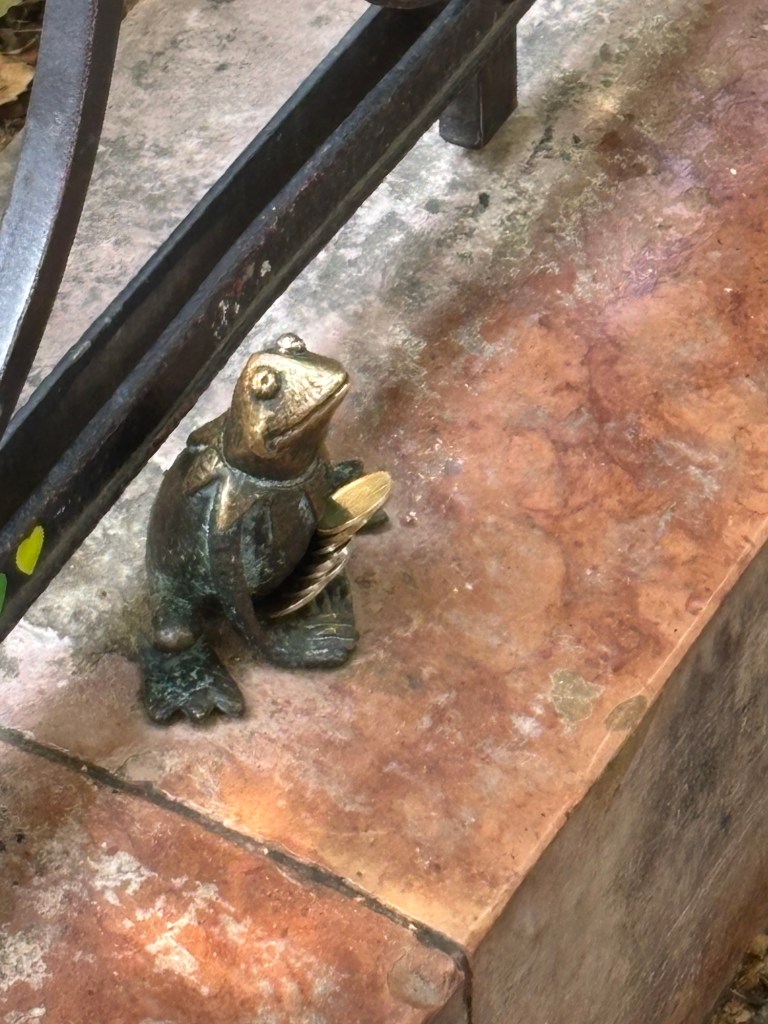
Other ‘random’ statues and sculptures can be found across the city.
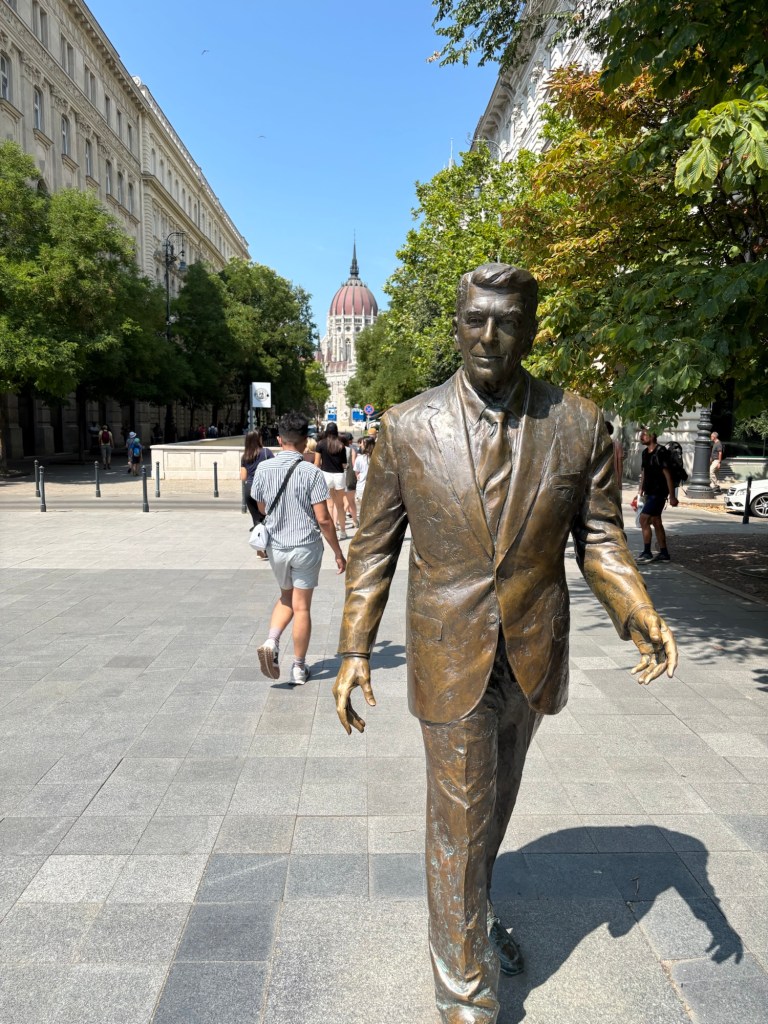
A bronze statue of former US president, Ronald Reagan, is located in Liberty Square and commemorates his support for Hungarian independence.
Reagan never visited Budapest whilst president but is famously quoted when meeting then Russian president Mikhail Gorbachev.
In that meeting he demanded: “Mr Gorbachev take down that wall.”
The Hungarian people still love Reagan because of his support for their independence and freedom.
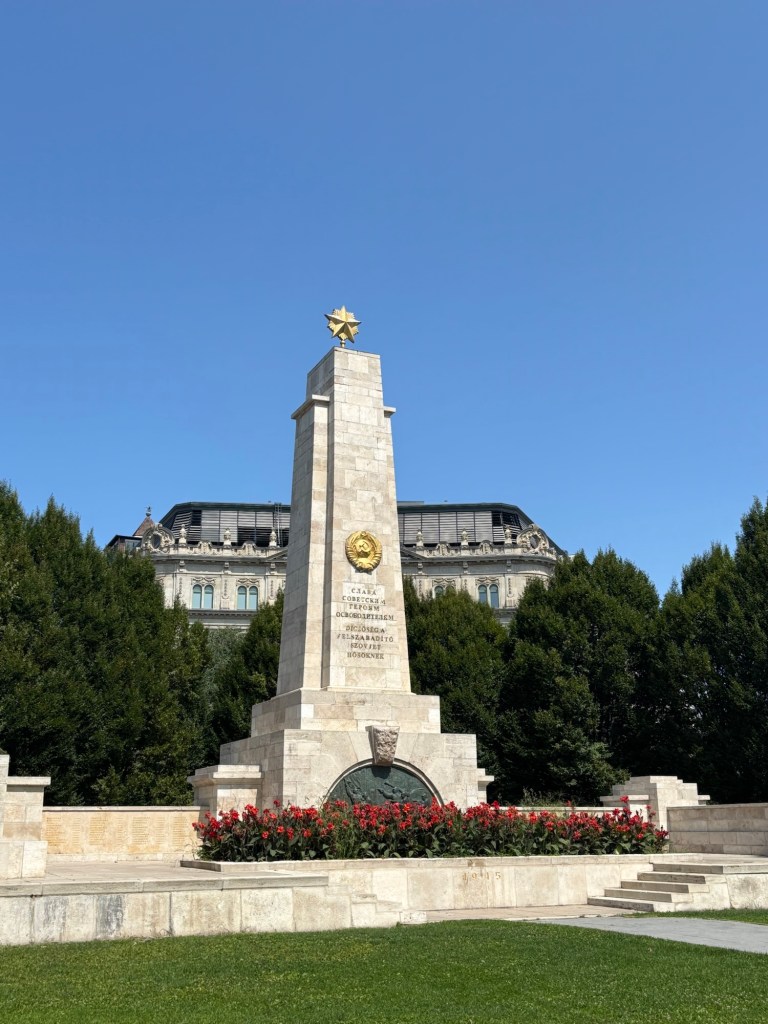
The most prominent monument on nearby Gellért Hill, is the Liberty Statue (Szabadság-szobor).
This commemorates the soldiers of the Russian Red Army who liberated Hungary from Nazi occupation in 1945.
While the female figure holding a palm frond remains, the Soviet soldier statues were removed to Memento Park after the 1989 transition to democracy.

Whilst modern day Hungarians recognise and appreciate the efforts of those Soviet soldiers who battled to liberate Budapest the statue is controversial because of the subsequent Soviet impact on Budapest during nearly 50 years of restrictive communist control.
During the communist era these same Soviet liberators were to be responsible for persecuting thousands of locals out of their homes and was directly responsible for the Hungarian Revolution of 1956 (23 October – 4 November 1956; also known as the Hungarian Uprising, which was an attempted countrywide revolution against the government of the Hungarian People’s Republic (1949–1989) and the policies caused by the government’s subordination to the Soviet Union.
The uprising lasted 15 days before being crushed by Soviet tanks and troops on 7 November 1956.
Tragically, thousands were killed or wounded, and nearly a quarter of a million Hungarians fled the country. Communist rule was to continue for another 33 years.
Unlike Bratislava and Bucharest, Budapest has a much reduced influx of the grim ‘Soviet style’ architecture that was so representative of the communist ideology during the Cold War.
Our tour guide told us that whilst the revolution was suppressed it did at least influence Soviet attitudes towards the Hungarian people to soften a little, with the result that Hungary was recognised as one of the ‘happiest places in the eastern block’
This did seem true. The Hungarians we met were polite and very friendly.
‘Eggashegader’ as we like to say in Budapest!
Cheers!
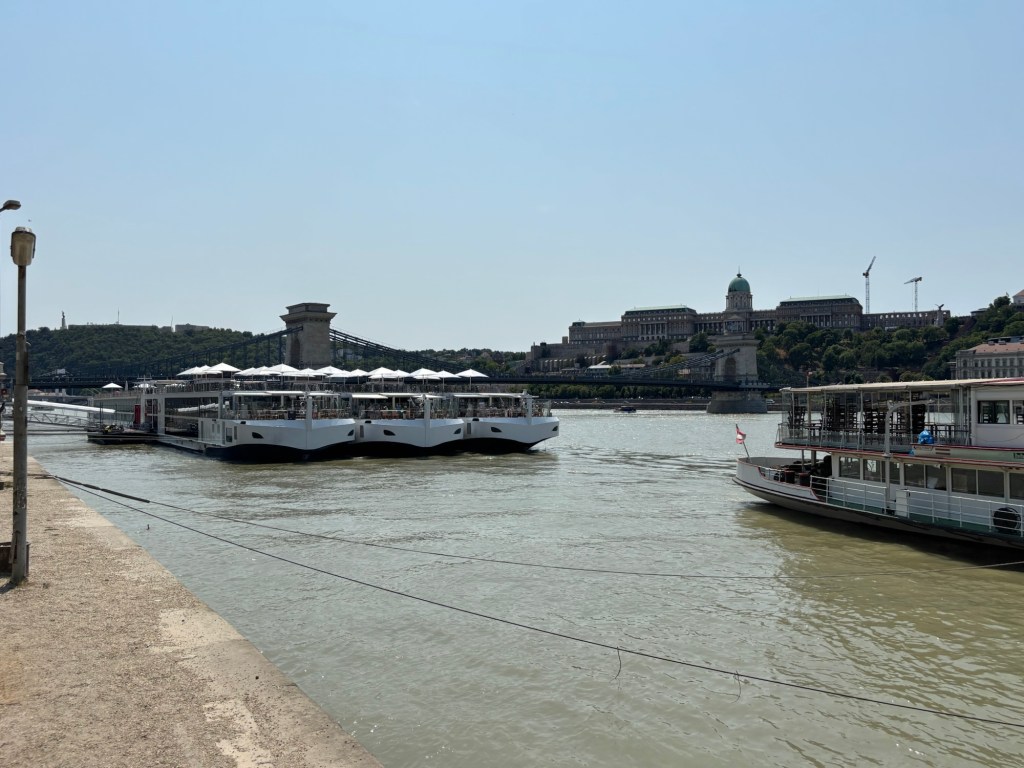
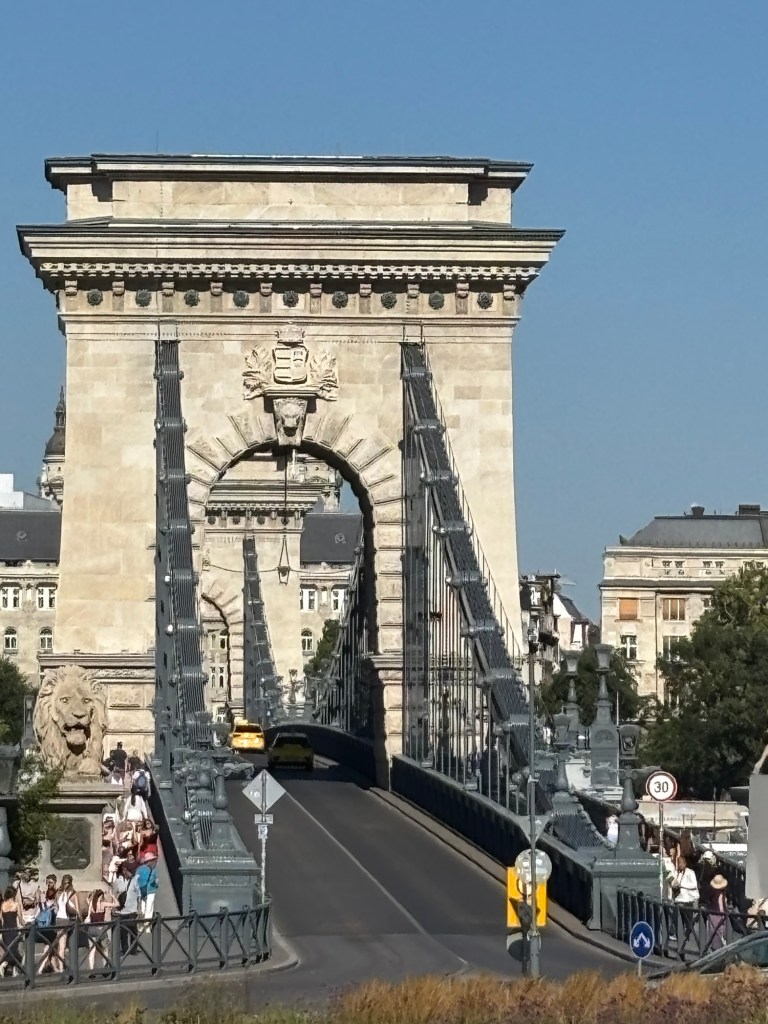
The famous ‘Chain bridge’ spans the Danube and connects Buda with Pest and was built by a Scottish engineer called William Tieney Clarke.

It provides a central observation point for the tourist to coordinate most of the city’s eye catching sights.
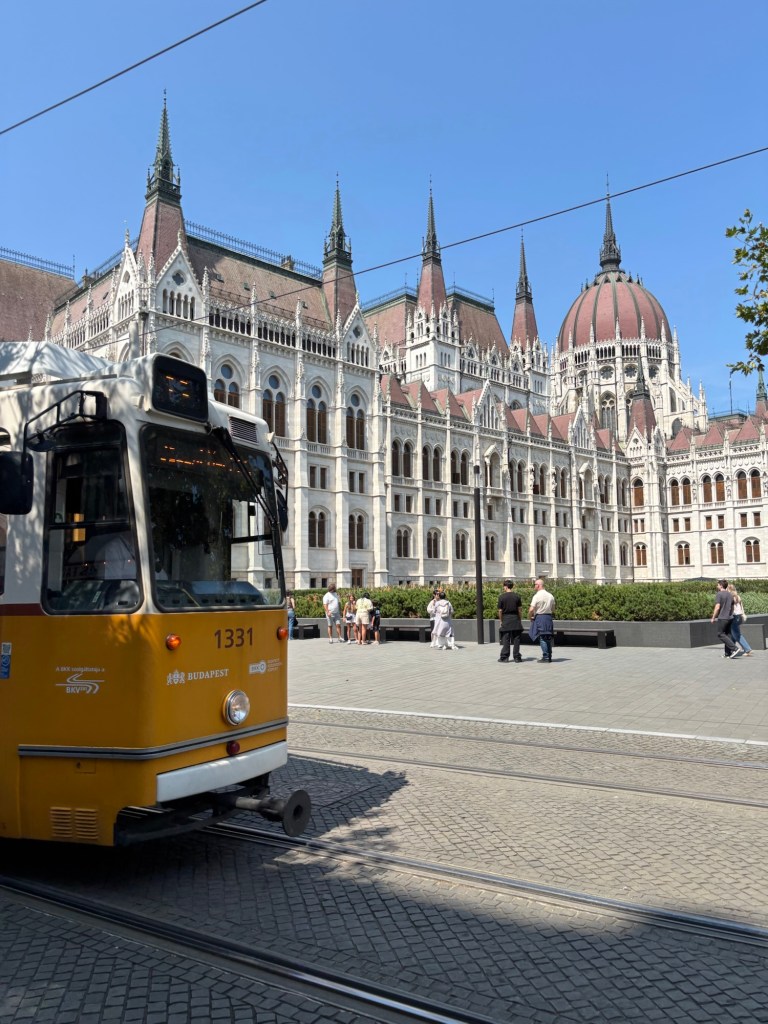
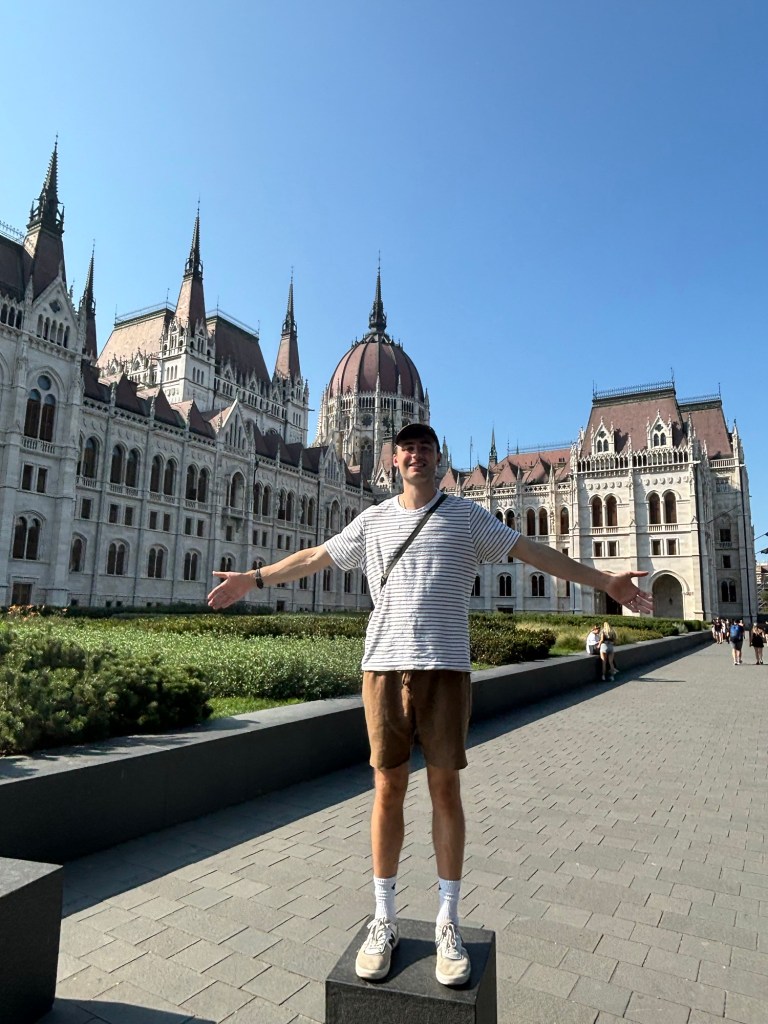
The modern parliament buildings dominate Kossuth square alongside the river Danube. These are the 3rd largest parliament building in the world after the White House in Washington and the People’s Parliament building in Bucharest.
Hungary’s legendary rivalry with Vienna meant that its parliamentary building had to be bigger and better than anything in the Austrian capital. It has 20 km of stairs and took 70 years to build.
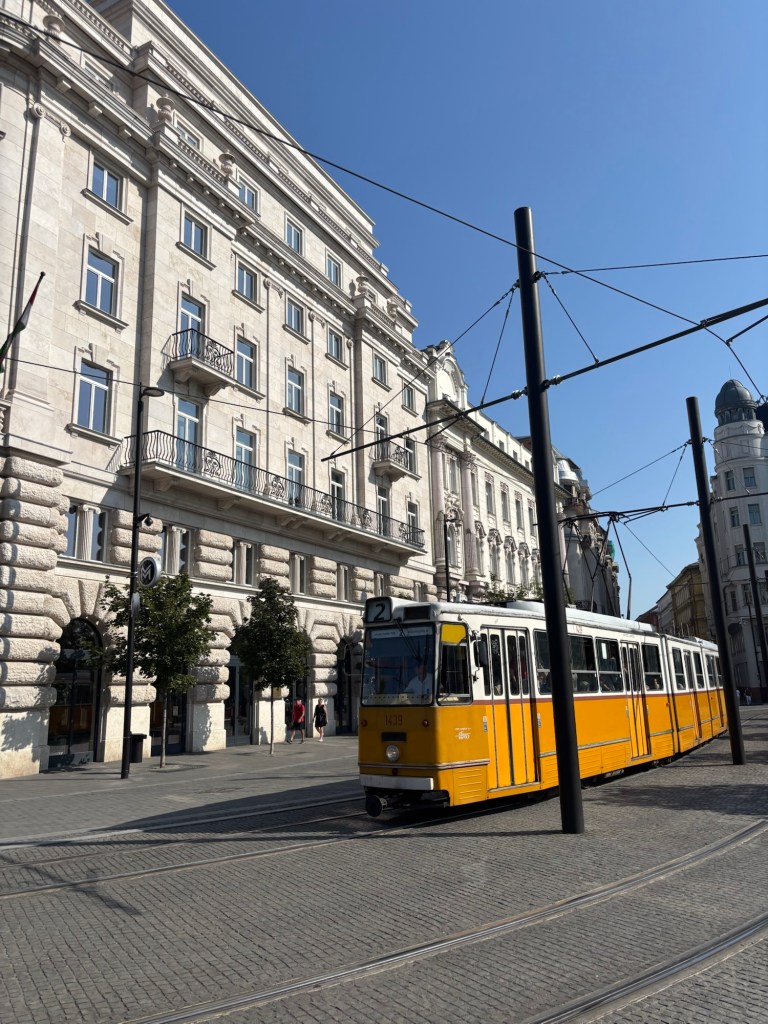
Taking the number 2 tram will provide the tourist with a visual tour of the Parliament and Buda side of the river.
Freddy Mercury, lead singer of Queen, actually wanted to buy the building after the band’s played in front of 70,000 fans in their final world tour in 1986, just 3 years before the fall of communism in Budapest.
Before a note was even played, the show on July 27th, 1986 was loaded with significance, representing the first concert performed by a stadium-league Western European rock band behind the Iron Curtain. “We like going places where it’s a challenge,” noted Brian May – and that certainly applied to a country where Communist strongman György Lázár still held sway.
A bizarre little known fact connects the music industry with the Hungarian uprising of 1956. Apparently, iconic American singer Elvis Presley, was so moved by the stories of the failed uprising that he organised a spontaneous ’crowdfund’ after singing “Peace in the Valley” on The Ed Sullivan Show in 1957, using his performance to ask for donations for Hungarians. This act of solidarity led to Budapest naming him an honorary citizen and a park after him in 2011.
We visited the imposing Buda castle in Pest but didn’t have time to go in. Next time hopefully.
Thee are significant numbers of thermal baths in the city. Given the hot summer weather we deliberately chose to avoid these on this visit. I would strongly recommend that a thermal spa session is an affordable ’must do’ for the tourist visiting in the spring, autumn and winter months. The biggest and most impressive is Széchenyi Thermal Bath where a day ticket costs approximately £30/€30.
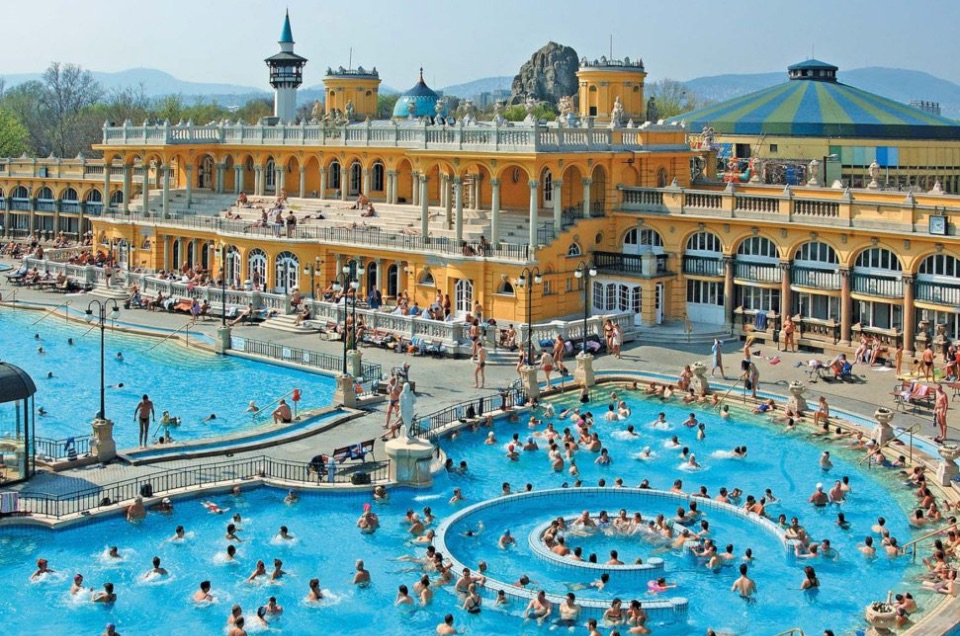
The Roman influence on the development of Budapest is epitomised by these spas. With more than 100 thermal springs that feed more than 50 bathhouses and thermal spas with 70 million litres of thermal water each day, Budapest is justified in claiming to be the ‘Spa capital of the world’

Vienna Budapest Bratislava Belgrade all lie with a few hundred kilometres of each other. Whilst all are impressive city breaks in their own right, it is my opinion that Budapest is the jewel in that particular crown.
As I move towards concluding this review of such a stunning city I do need to attempt to do justice as I briefly acknowledge the significance of the Jewish community in the development of the city as it is today and to recognise and respect their tragic role just 80 years ago as World War 2 moved towards its concluding climax.
The Jewish Ghetto bears long lasting testimony to the lives of thousands of normal people that were sacrificed on the altar one man’s fanatical ideology.
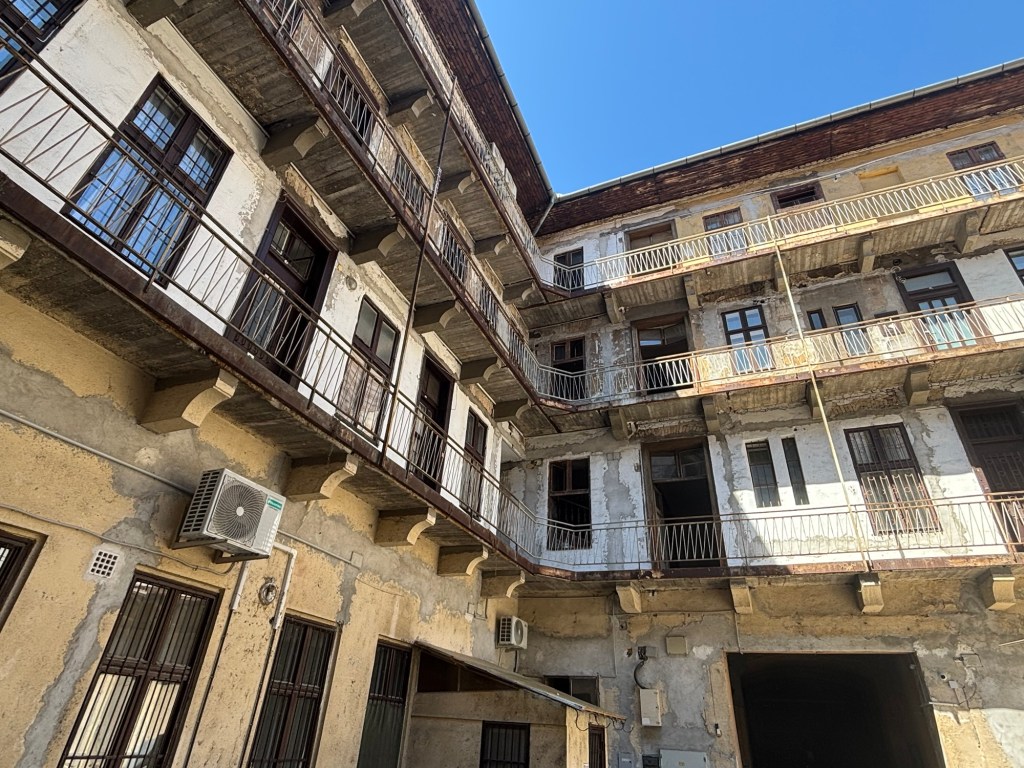
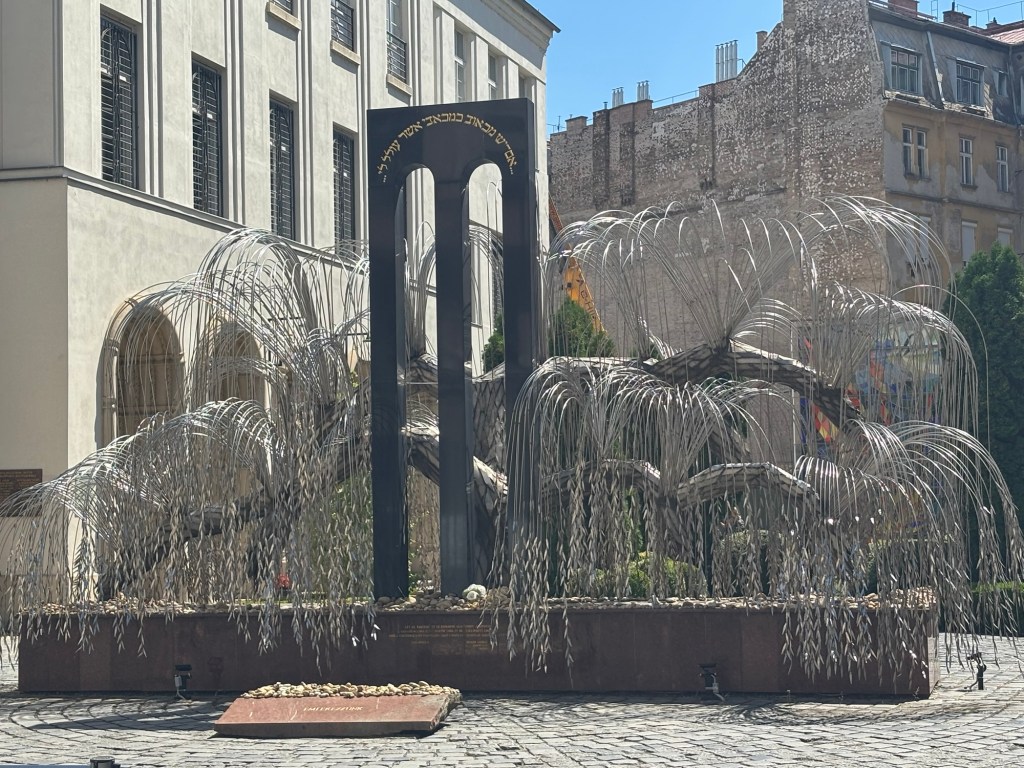
Over 500,000 Jews were deported to Auschwitz by the Nazis for extermination with the full cooperation of the then Hungarian government from 1944-1945.
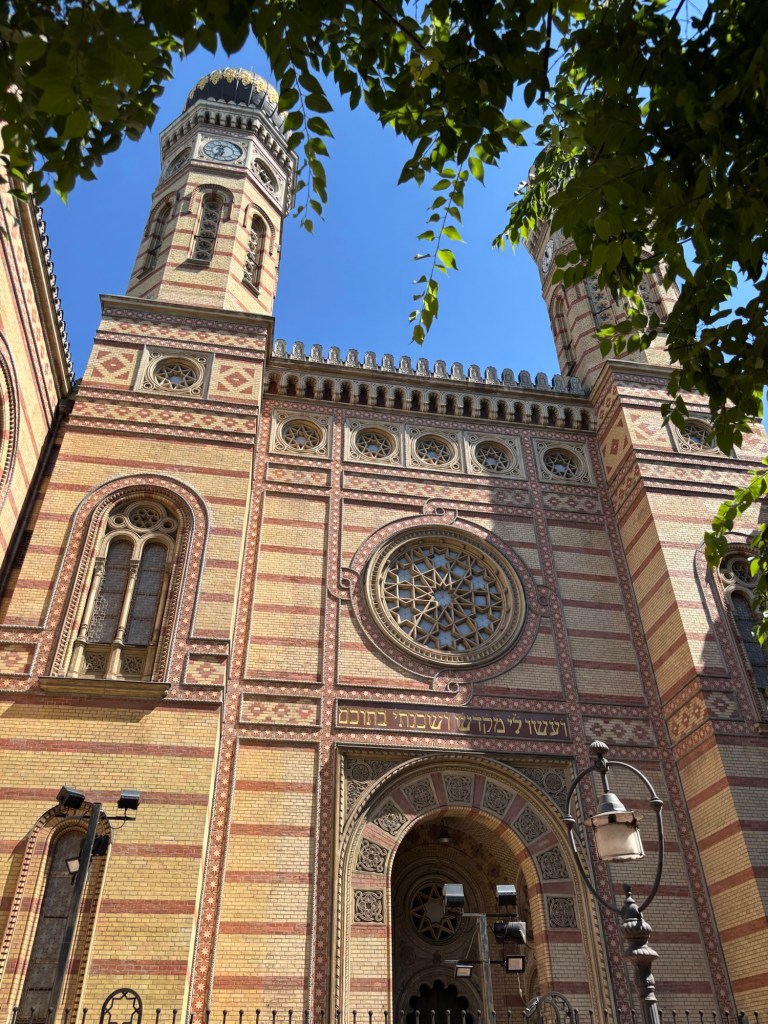
A steel tree in the grounds of the Grand Synagogue commemorates their destruction.
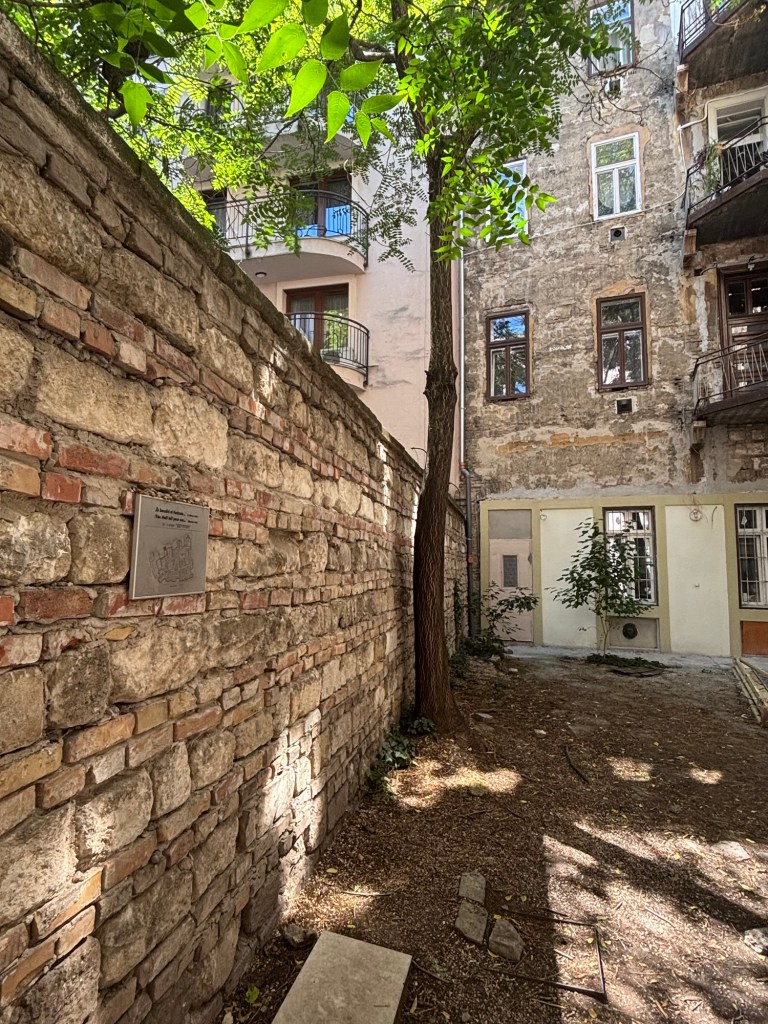
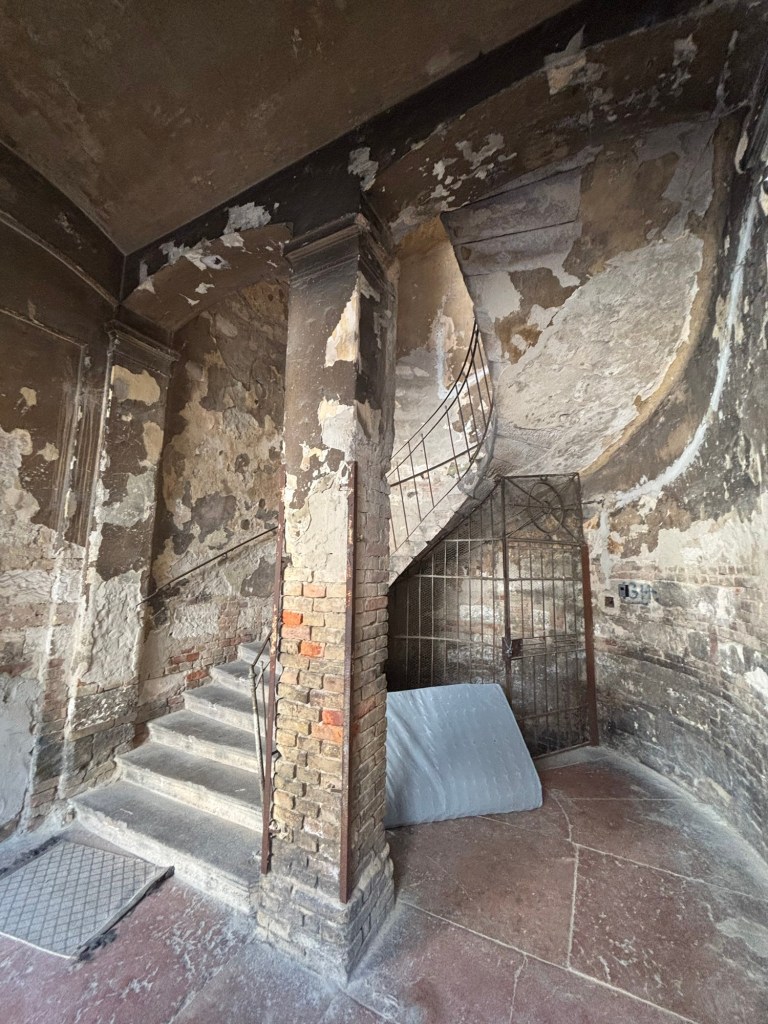
The winter of January 1945 was bitterly cold and the river Danube froze with daily temperatures of -30 recorded.
The iconic ‘Shoes on the Danube’ sculpture testifies to the 3500 locals who were told to remove their shoes and valuables before being shot and falling into the river during that bitter winter.
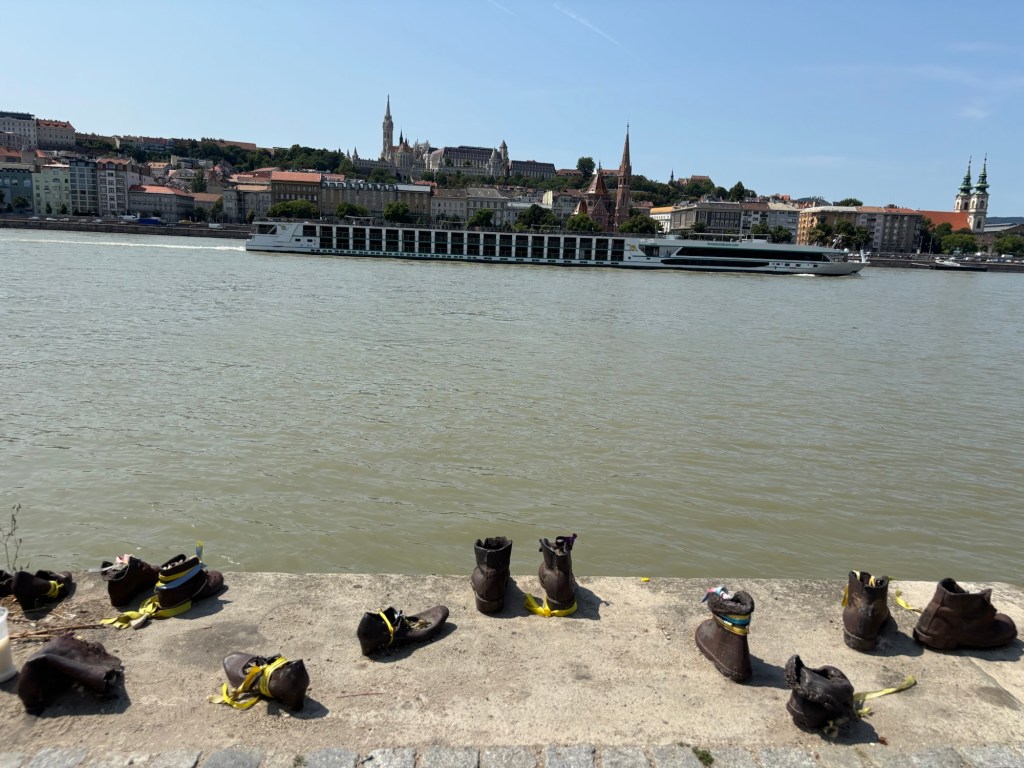
Whilst the Budapest of 2025 is an attractive, modern and liberal city those hideous genocidal actions by the Nazis still remind us of man’s frequent inhumanity towards his fellow man.
This simple sculpture powerfully cements the reality that whilst fanatics can destroy so many human lives they cannot erase the memory of people from a city’s history.
It is a beautiful sculpture. Visiting it touches this particular tourist’s soul.
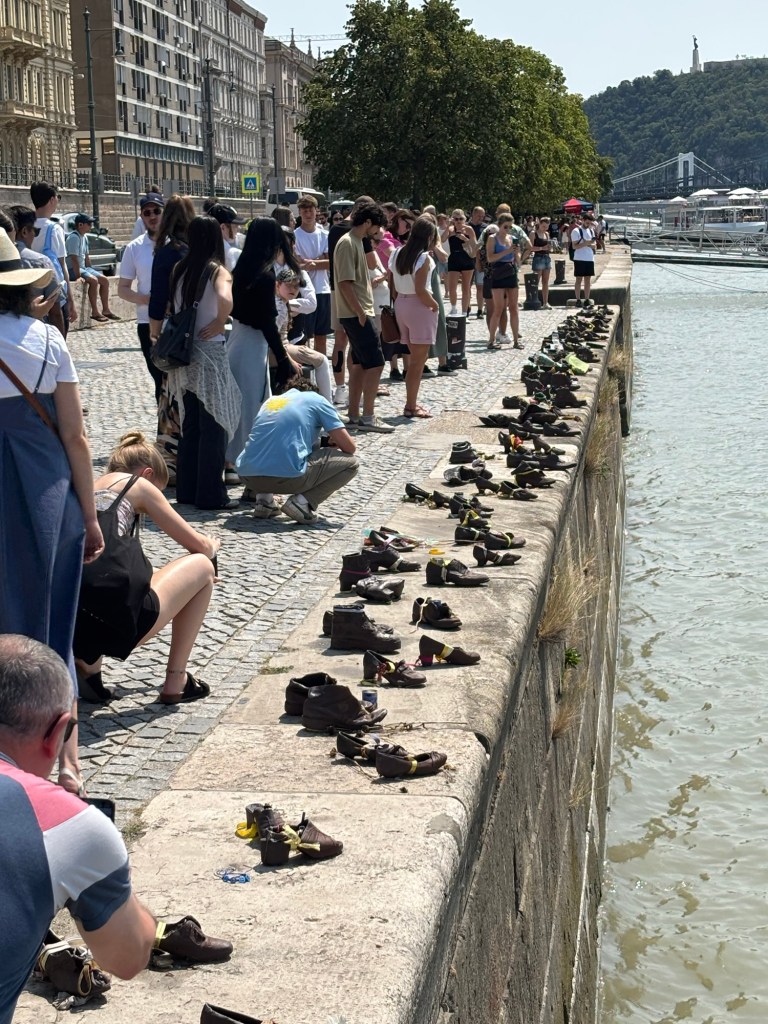
It remains an emotional moment viewing and then photographing this rusted sculpture that illustrates so evocatively, the fragility of human life and the magnitude of human suffering.
The Jewish culture that so markedly influenced the development of the city of Budapest is still significant today.
The city houses the 2nd largest synagogue in the world: it actually still has 3 active synagogues supporting the spiritual and practical needs of the 70,000 Jewish people who still live in the city today.
I guess that’s what makes a visit to Budapest such a wonderful experience.
There really is so much to see, so much to read, encounter and learn in this truly magnificent city.
Jake and I were incredibly privileged to be able to enjoy a second visit to this incredible city.
We cannot recommend a visit to Budapest highly enough.
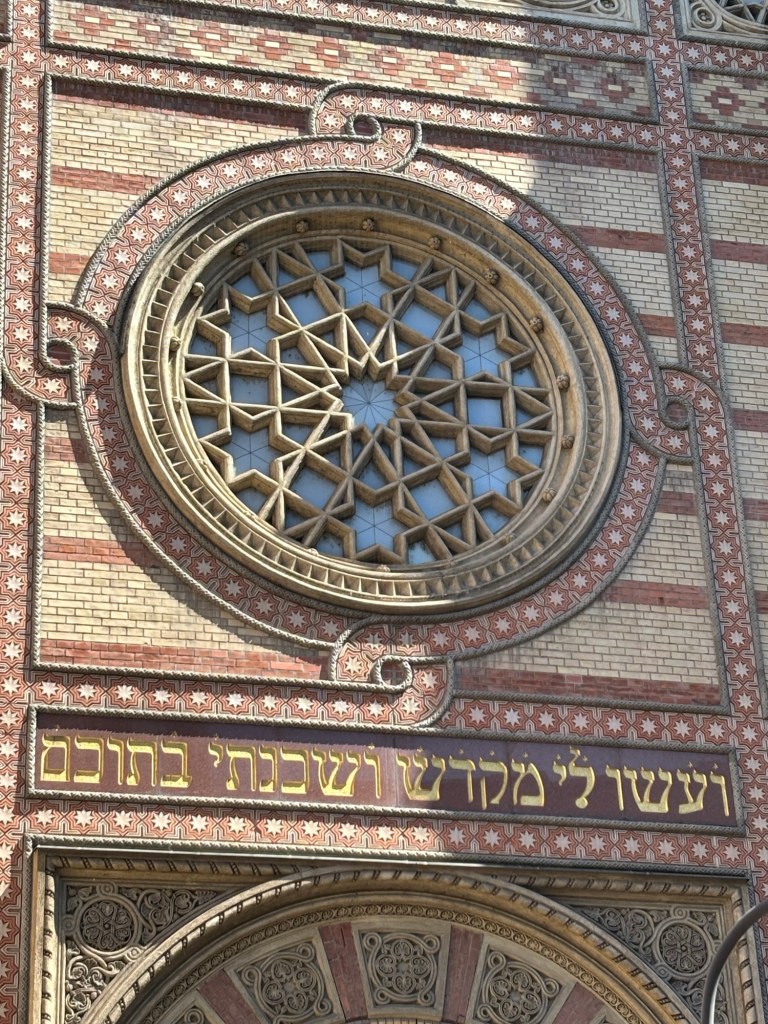
The old Jewish saying “You shall tell your sons” is lifted straight from the Old Testament and refers to the Bible passage Exodus 13:8, which instructs parents to teach their children about God’s deliverance from Egypt.
A look at modern day Budapest, reminds us of many things: that human perseverance is an astonishing thing, that the human spirit cannot be crushed and that people of all ages, abilities and faiths truly deserve our respect.
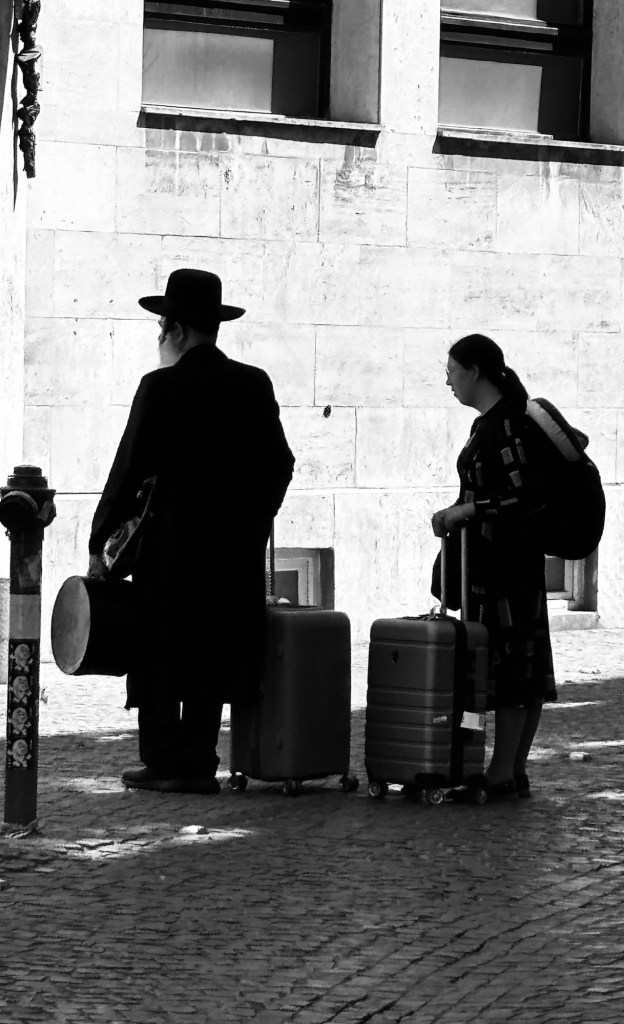
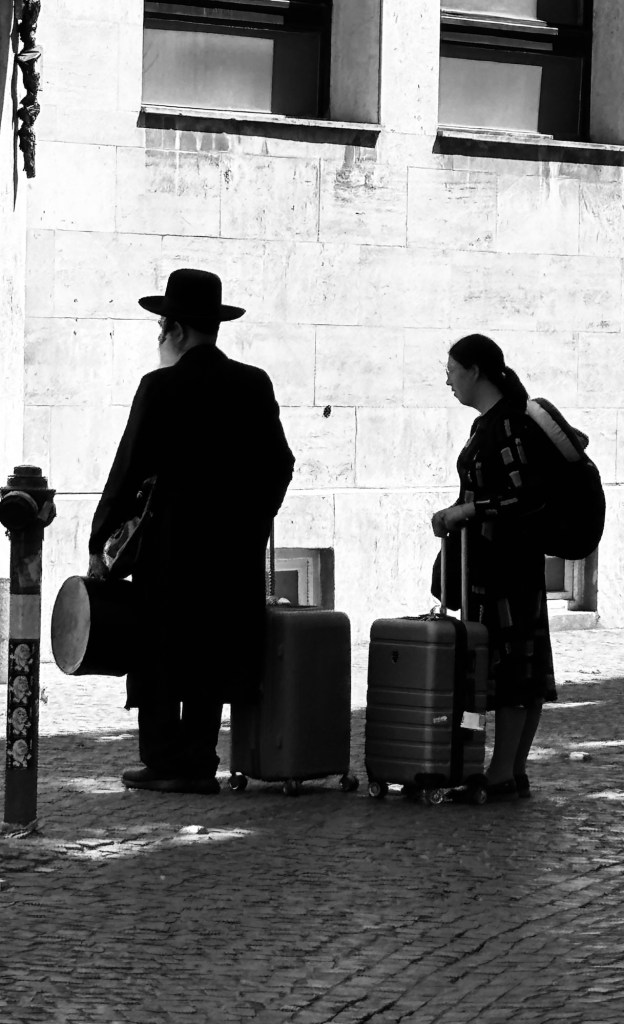
As we concluded our feee city tour on that hot Friday afternoon I was fortunate enough to see an orthodox couple walking down the street towards one of the synagogues.
In a fleeting second I managed to snap this timeless photograph.
It could have been taken at any time over the course of the last 150 years.
I felt a cocktail of emotions as I took that simple enough photograph: respect, and admiration, but most especially gratitude: gratitude that people can still be true to their culture and themselves in this jewel of a city on the banks of the river Danube.
In our modern world where creature comforts are so available it is good to revisit the past and to remind ourselves of the importance of our forefathers.
I would have loved to interview and photograph that Jewish couple: their life story must be so interesting.
Thanks for the read. Any comments or observations are always welcome.
Best wishes
Martin
Martin and Jake Moorman travelled to Budapest for 3 nights in August 2025.
Flights via international airline Ryanair, from Manchester or Leeds Bradford airports can be easily sourced and can be as cheap as £10 each way.
Affordable accommodation can be easily accessed via the Airbnb and Booking.com websites.
At the time of writing 420 Hungarian Forints equaled £1.
Easting out is reasonably priced with a meal for 2 with a drink costing less than £20/€20 per person.
 Martin Moorman